No More Duck Bands? What That Might Mean for Hunters
Posted 2025-10-23 by
The current federal budget impasse has paused banding efforts, and proposed cuts threaten the banding program’s existence
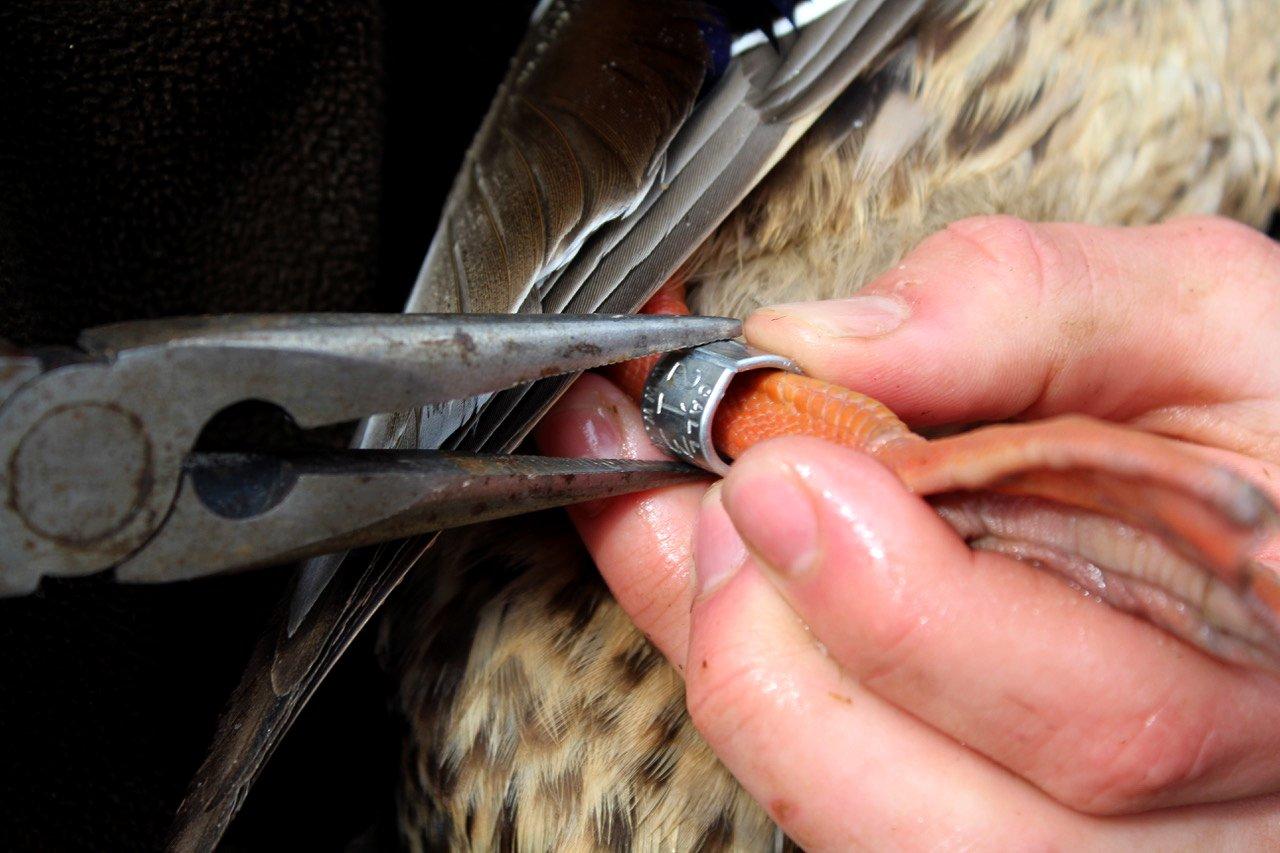
Waterfowl banding efforts provide scientists with insights into migration, reproductive success and bird populations. Photo by Dr. Doug Osborne.
If you shoot a banded duck or goose in the next few weeks, you’ll probably have to wait to receive info about the bird. And that delay might foreshadow even more trouble for the country’s long tradition of migratory bird research.
Because of the current congressional budget impasse and resulting government shutdown, the U.S. Geological Survey’s Bird Banding Laboratory in Patuxent, Maryland, has closed temporarily, pausing the processing of banding report responses and other banding activity. An update on the banded-bird reporting website, reportband.gov, said band reports submitted will be stored and processed when normal operations resume.
That’s frustrating for hunters, but the problems might not end there. The current issue is separate from, yet compounded by, a plan to essentially eliminate the USGS’ Ecosystems Mission Area, which houses the banding laboratory. The proposal, included in the president’s fiscal year 2026 federal budget proposal, would shrink the EMA’s budget from about $293 million in 2025 to $29 million and lay off thousands of Department of Interior employees. The cuts are not set in stone. The House Interior Appropriations Committee approved a bill that provides about $289.8 million for the EMA, and the U.S. Senate also approved funding for the program, rejecting its proposed elimination. The final budget for fiscal year 2026 has not yet been determined.
Don’t Miss: How Waterfowl Limits are Set
Biologists and conservationists say ending the bird banding program would cause a huge loss of ecological data, which would be catastrophic for conservation and waterfowl hunting.
“Eliminating the BBL would be a massive mistake because that lab provides pretty much a large majority of the data used to manage waterfowl populations,” said Michael Schummer, senior research associate and Roosevelt waterfowl ecologist with the State University of New York College of Environmental Science and Forestry, and creator of the FowlWeather Podcast. “It is not easily replaceable, and without that information, we would likely need to be more restrictive with hunting seasons — not because harvest had anything to do with populations of some species, but because you would have to invoke a conservative harvest approach in the face of no information.”
The BBL issues about 1 million bird bands per year and has distributed more than 79 million bands across North America since 1920, supporting United States and Canadian banding efforts.
Don’t Miss: Hot-Spotting and Duck Hunting Pressure
Researchers fit birds with aluminum leg bands engraved with a number. That number — plus information on the age, sex and species of the bird — is sent to the BBL, where it’s kept in a database. Through its history, the lab has recorded about 6.5 million band encounters, including harvest recoveries and re-sightings, establishing it as one of North America’s most important long-term wildlife data sets.
The program is especially important for waterfowl. From 1960 through Oct. 20, 2025, according to USGS, the BBL recorded banding data for almost 15.1 million ducks and more than 6.6 million geese. It’s also recorded more than 2.44 million subsequent encounters with banded ducks (about 16% of the total banded ducks) and more than 1.9 million with banded geese (about 29% of the total banded geese). Banding data allows insights into waterfowl migration, reproductive success and population trends. Further, it lets researchers monitor the ratio of juveniles to adults and compile annual survival rates — especially the critical survival rates of adult females. That information is then used to manage waterfowl populations.
“The USGS Bird Banding Lab, USFWS Migratory Bird Office, and USFWS National Wildlife Refuge System provide substantial benefits to hunters, the environment and our economy, but have basically had flat-lined budgets and threats of cuts for years,” Schummer said. “None of this is new. It’s like not getting a raise for a decade — makes it hard to do business. All the talk now of government inefficiency seems to be whitewashed and throws all these passionate conservationists into the same pool, when in fact, they are not. A good majority of them hunt, and they are doing their best with what they have. The reality is that all the budgets of each of those noted should be going up, not down.”
Don’t Miss: How to Pull Off a Great Free-Lance Duck Hunt