Motorist Hits Mountain Lion in Arkansas
Posted 2025-10-20 by
Only three mountain lions have been found dead in the state since 1975
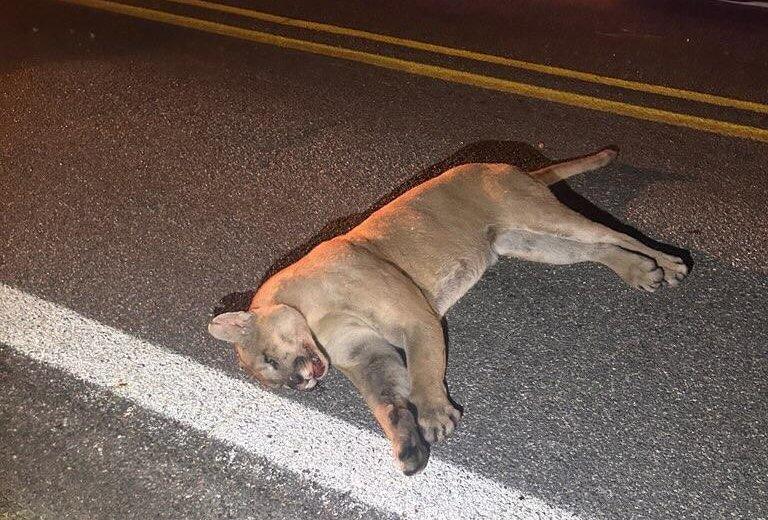
A motorist hit and killed a mountain lion on Arkansas Highway 84. It’s one of three dead mountain lions reported in Arkansas since 1975. (Photo by Arkansas Game and Fish Commission)
A mountain lion struck and killed by a vehicle in Hot Spring County, Arkansas, is only the third confirmed mountain lion found dead in the state since 1975.
According to the Arkansas Game and Fish Commission (AGFC), the big cat was killed on Arkansas Highway 84 near exit 91 on October 8. It is the first mountain lion confirmed dead in the wild since February 2024.
A healthy male, the cat measured 83 inches from the tip of the tail to the tip of the nose and weighed approximately 160 pounds. The AGFC is collecting samples to send to an independent laboratory for analysis to determine its origin and age.
Native to the state, mountain lions were wiped out in 1920 by unregulated hunting and habitat loss. Sightings of the big cats began to be recorded as their populations increased in Western and Midwestern states. The AGFC says there’s no confirmed evidence of a reproducing population in the state, but it has confirmed 43 sightings in the state since 2010. These sightings may be of the same few individuals as they cross the state. No sightings of female lions with cubs have been recorded.
“Male mountain lions are known to roam, sometimes crossing multiple states,” Spencer Daniels, AGFC Large Carnivore Program coordinator, said.
Don’t Miss: Anti-Hunters Hijack Florida Bear Drawing
A mountain lion shot and killed by a deer hunter in 2014 was tied back to a known population from the Black Hills Region of Wyoming and South Dakota.
Recent social media posts indicate a mountain lion in the area of DeGray Lake. The cat killed by the vehicle may be the one in these images, but there is no way to confirm it is the same mountain lion.
“We would need DNA evidence from the sites where the photos were taken to do a comparison, and so far, no one has been able to produce any hair or other genetic material to do such analysis,” Daniels said. “We have many unconfirmed sightings each year, but we need some sort of physical evidence such as hair, tracks, scat or photos to officially confirm a mountain lion was present. Many photos are sent in of bobcats, house cats, coyotes, dogs and other animals from trail cameras that are blurred or have no reference to determine true size, and later analysis concludes that the subject of the image is not a mountain lion.”