Kentucky
952,000
Est. Whitetail Population
280,000
No. Licenses Sold Annually
$62
The annual resident hunting license is $27. The deer permit is $35.
Resident hunting license and deer permit
$335
The annual non-resident hunting license is $160. The deer permit is $235.
Non-resident hunting license and deer permit
204 2/8"
Taken by Robert W. Smith in Pendleton County in 2000, ranked as No. 7 of all time.
Record B&C Typical Stat
839
Total B&C Typical Entries
274 5/8"
Picked up in Christian County in 2019. It ranks 31 overall.
Record B&C Non-Typical Stat
416
Record B&C Non-Typical Entries
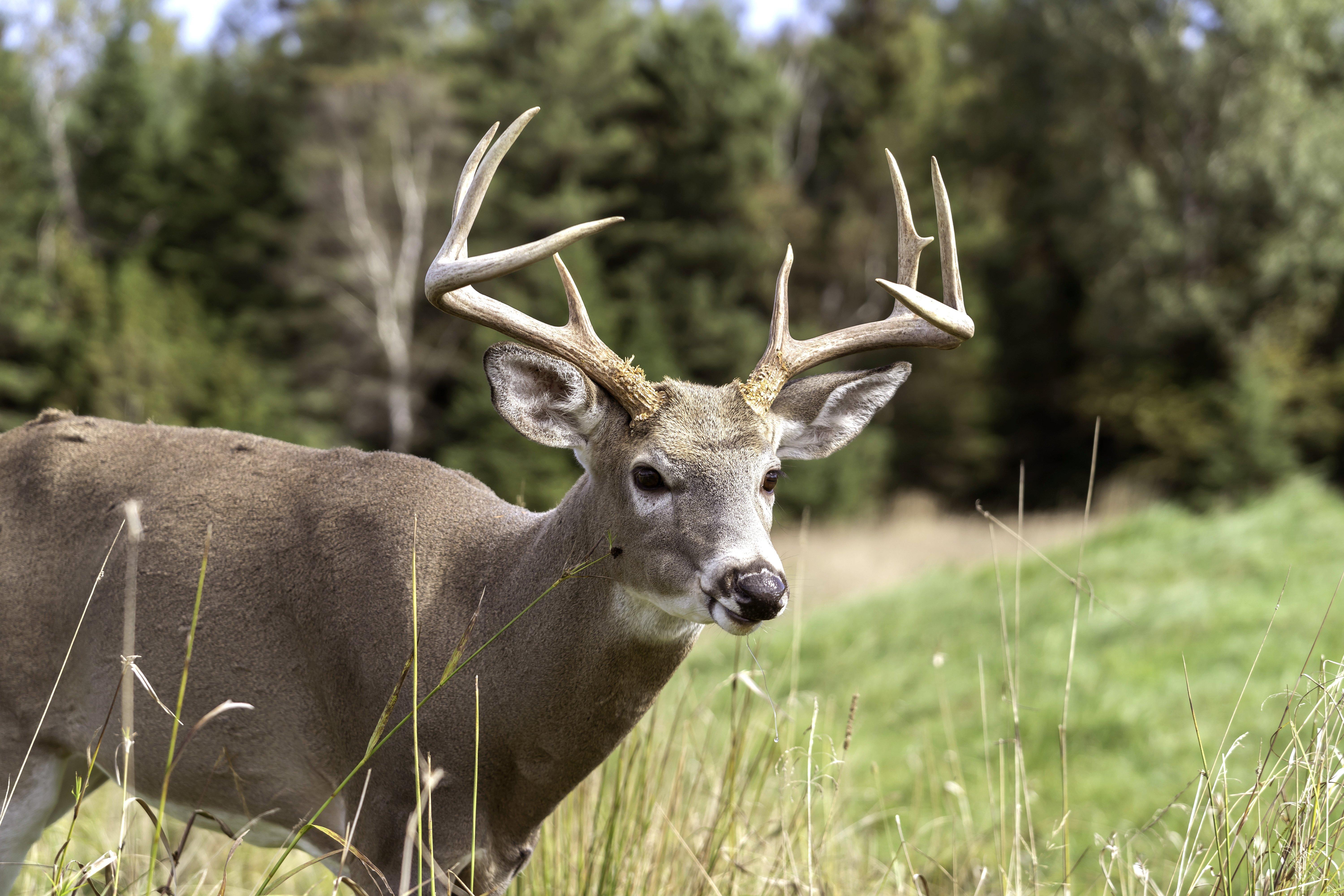
Check out the latest deer-hunting info for Kentucky. Image by Patrick Messier
Season Dates (2025):
Kentucky’s 2024 archery season is Sept. 6 to Jan. 19. Crossbow season spans Sept. 20 to Jan. 19. Modern firearms season is Nov. 8 through 23. Early muzzleloader season is Oct. 18 and 19, and late muzzleloader runs Dec. 13 through 21. Youth season is Oct. 11-19 and Dec. 27 and 28. Please check the Kentucky Department of Fish and Wildlife Resources WEBSITE to confirm.
The Grade: A
Kentucky is no longer a secret. Hunters travel from afar to see what the hype is all about. Some go home empty-handed, but many experience what they came here for — great deer hunting.
Chronic wasting disease was discovered in Kentucky during the 2023 deer season, after a single buck taken in Ballard County tested positive. Because of that, and due to other positive cases in Tennessee, the current CWD Surveillance Zone includes Ballard, Breckinridge, Calloway, Carlisle, Fulton, Graves, Hardin, Henderson, Hickman, Marshall, McCracken, Meade, Union, and Webster counties. Special mandatory sampling and carcass-transportation regulations apply.
Despite that, it’s hard not to give Kentucky an A based on Antler Nation criteria, especially considering it might be the best place in the country to tag a big velvet whitetail.
Records information courtesy of Boone & Crockett’s Big Game Records. Learn more at boone-crockett.org
Antler Nation Knowledge
The Bluegrass State is diverse. Western Kentucky offers flat agricultural land similar to the Midwest. The entire northern and western edges of the state are bordered by rivers, which produce fertile soils and great river-bottom whitetail hunting. Expansive forests are found in the state’s central and eastern portions, and eastern counties harbor some rugged mountainous terrain. Central Kentucky has a good mix of rolling hills, hardwoods, crops, and pasture fields.
“Every county in Kentucky has produced trophy whitetails and continues to do so annually,” said Kyle Sams, deer and elk program biologist for the Kentucky Department of Fish and Wildlife. “However, I would focus on the Green River Region counties, where we typically get more trophy whitetails. Our hunters do a great job of letting younger bucks and buck fawns walk, as 71% of the males harvested are adults (2.5 years or older), 19% of the males harvested are yearlings (1.5 years old) and 10% of the males harvested are fawns (0.5 years old).”
When it comes to top-end bucks, it’s hard to beat counties that border the Ohio River and those in the western half of the state. Some of the best include Breckinridge, Butler, Christian, Daviess, Edmonson, Grayson, Hancock, Hardin, Hart, Henderson, Hopkins, Logan, Muhlenberg, Ohio, and Todd. Bullitt, Henry, Jefferson, Oldham, and Shelby are good, too, if you can find a place to hunt in these heavily populated areas. Still, a giant is possible anywhere in the state. Kentucky ranks behind only Wisconsin in Boone and Crockett entries from the past decade.
Dedicated hunters can find trophy bucks on public land, too. More than 1.5 million acres of public land are available, but much of it receives heavy pressure. Some of the larger WMAs in the Bluegrass and Green River regions offer the best chance at a trophy. However, pockets of private property are where most big bucks roam. Secure a decent piece of private ground in the state, and you’re well on your way to tagging a big whitetail. Interestingly, Boone and Crockett bucks have been taken in every Kentucky county except one.
And don’t forget, a statewide deer permit allows hunters to take up to four deer. If you don’t want all that meat, consider donating a deer or two to the HUNTERS FOR THE HUNGRY PROGRAM. People will appreciate it.