From How Far Away Can a Buck Bust You?
Posted 2026-10-20 by
Beating a whitetail’s senses is paramount to hunting success — and the challenge is formidable
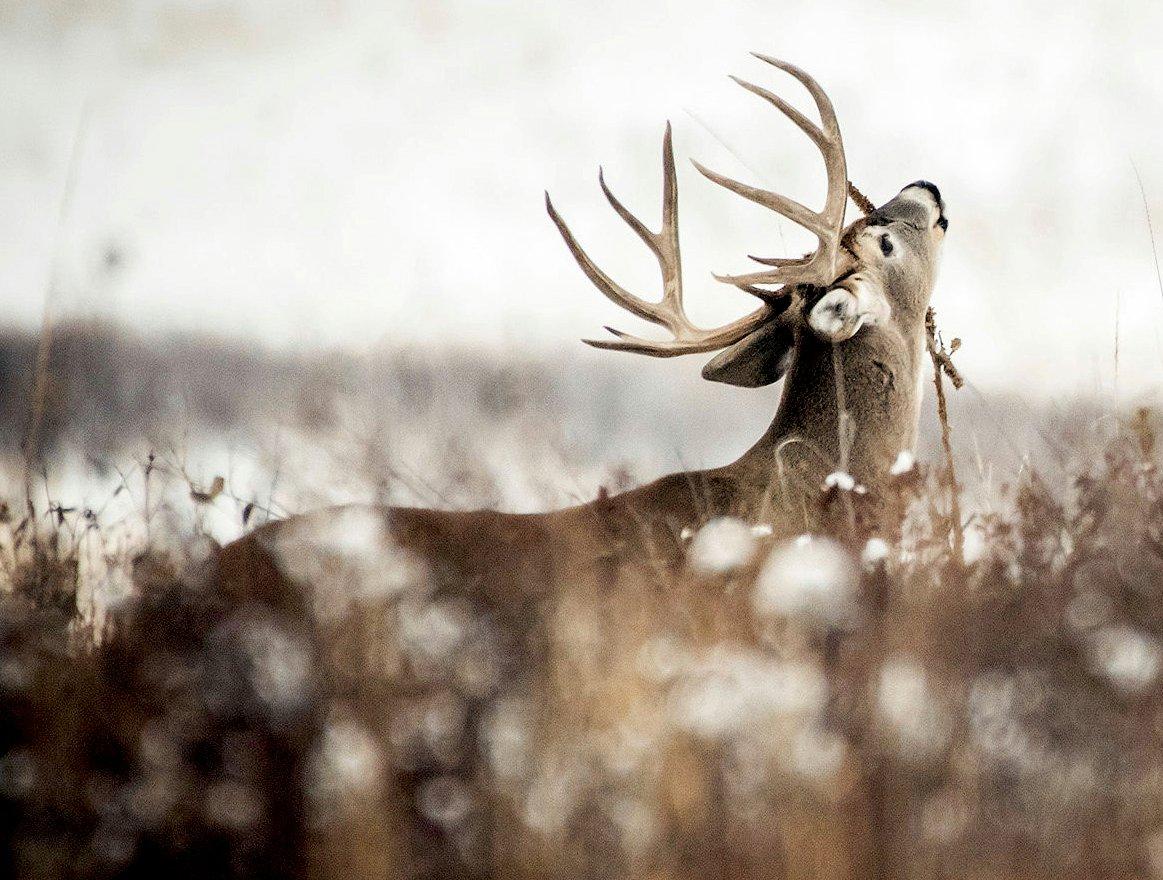
Experts say a buck might be able to smell you from a half-mile away during ideal scenting conditions. Photo by John Hafner.
To detect danger, a white-tailed deer relies on its superior nose, working in unison with an acute sense of hearing and decent, if imperfect, vision. Together, those senses create a threat-detection system that helps the animals avoid predators, including you and me. You’ve been picked off by does and bucks countless times, as I have, close in stands and during long walks in and out of the woods. Ever wondered just how far away deer can bust you?
THE NOSE KNOWS
A deer’s nose has 300 million olfactory receptors, compared to a human’s 5 million, making their sense of smell 500 to 1,000 times better than ours. Although no distances have been scientifically documented, noted deer researcher and photographer Leonard Lee Rue surmised from his many years in the field that during his ideal scenting conditions (50 to 70 degrees, with 50% to 70% humidity and a light breeze), a buck could smell you from a half-mile away — and possibly farther.
Wind, weather, and terrain are big factors. In open habitat on a cool, damp morning with stable air currents, I believe a buck could pick up particles of your scent 400 to 500 yards away. In thicker woods, trees, brush, ridges, and other terrain features break up and disperse air currents that carry scent. A deer might only smell you 100 to 300 yards away.
Don’t Miss: Shoot or Pass? The Riskiest Shots You’ll Face in the Whitetail Woods
No matter what terrain you hunt or the conditions, prioritize good scent control every day. Access stands and set up downwind or crosswind of where you expect and hope to see a buck. Apply an odor eliminator to your camo and boots at the truck, and spray again and refresh at your stand in the never-ending challenge of trying to fool a buck’s nose.
HEAR THAT?
Audiologists say a human with good ears can hear from 20 to 20,000 hertz, with our best and most sensitive range from 2,000 to 5,000 hertz. Deer researchers have found that whitetails hear best at moderate frequencies of 3,000 to 8,000 hertz. Deer hear better than we do, but not by much.
How far away can a buck hear a stick crack, or the rustle of you walking in the leaves, or you clanging your bow against a stand? It depends a lot on wind speed, terrain and foliage in an area. One November day with minimal wind, I called to an old buck crossing a wide-open bean field. He heard one grunt, threw up his head and turned my way. I ranged him at 320 yards, so I know for a fact that in open country a buck can hear a low to moderate sound at 300 yards.
What about where you hunt? Try this experiment on a clear, windless day. As a buddy hangs steps and a stand in a tree, walk straight away, and stop at various intervals until you can’t hear those metallic noises anymore. Walk back to the tree, and count your steps as you go. Depending on the terrain and density of cover, it might be 50 yards, or 100 or more. This will help you understand what you can and cannot get away with noise-wise on your hunts.
Don’t Miss: Does Ozone Really Work for Deer Hunting?
One more thing. Ever noticed how a walking deer suddenly stops, raises its head and flicks and rolls its ears like tiny satellite dishes? The animal is trying to home in on a sudden noise. If the doe or buck senses a potentially dangerous sound, it will turn, look and sniff the wind. If you made that sound — maybe cracked a stick with your boot or clinked your bow on your stand — freeze, because the deer is on to you. Stay calm and still, and the deer will often settle back down.
BEAT A BUCK’S EYES
Quick facts on deer vision: They see roughly 20/60, about three times worse than a hunter with 20/20 eyesight. Although objects appear blurry, deer compensate with superior, almost supernatural, motion detection. A buck’s eyes on the sides of its head allow for an amazing 300-degree panoramic view of his surroundings. A deer’s eyes are most oriented to pick up predator movement for a mile on or just below the horizon. A final biggie: Deer have a reflective layer in their eyeballs, which provides incredible night vision.
That sounds impressive, and it is, but it’s not that hard to beat a deer’s eyes if you do three things: Avoid sudden and unnecessary movements; hunt as motionless as you can; and when you must move, do it smoothly and at the right time.
Say you’re in a tree stand and there’s a buck at 30 yards or even walking across a cut bean field at 300 yards. That deer will bust you if you fidget too much or make a sudden fast move. Although the animal cannot see you in detail, he picks up that predator movement and goes on red alert. If you freeze and stay low and hidden, a buck might stamp his foot and look for a minute. If he doesn’t wind you, he might even settle back down.
Don’t Miss: 5 Stand Access Mistakes That’ll Get You Busted Every Time
At dawn and dusk, when we are usually out there and when deer typically move and see the best, it’s imperative to cut down movement and be as still as possible. In a stand, turn your head slowly and cut your eyes to look for deer. No fidgeting or checking your phone. When a buck approaches, move smoothly to draw your bow or swivel your rifle only when his head and eyes are behind a tree or brush. When he steps out in range, take him quick as you can.