Rack Report | North Carolina Bowhunter Arrows Possible New Orange County Record Whitetail
Posted 2026-10-20 by
Graham Smith had hunted the giant buck since 2022 and finally got a crack at it this bow season
| Rack Report Details | |
|---|---|
| Buck: | 203 5/8" |
| Time of Year: | Sept. 13, 2026 |
| Place: | Orange County, North Carolina |
| Weapon: | Hoyt AX-3 29 compound bow |
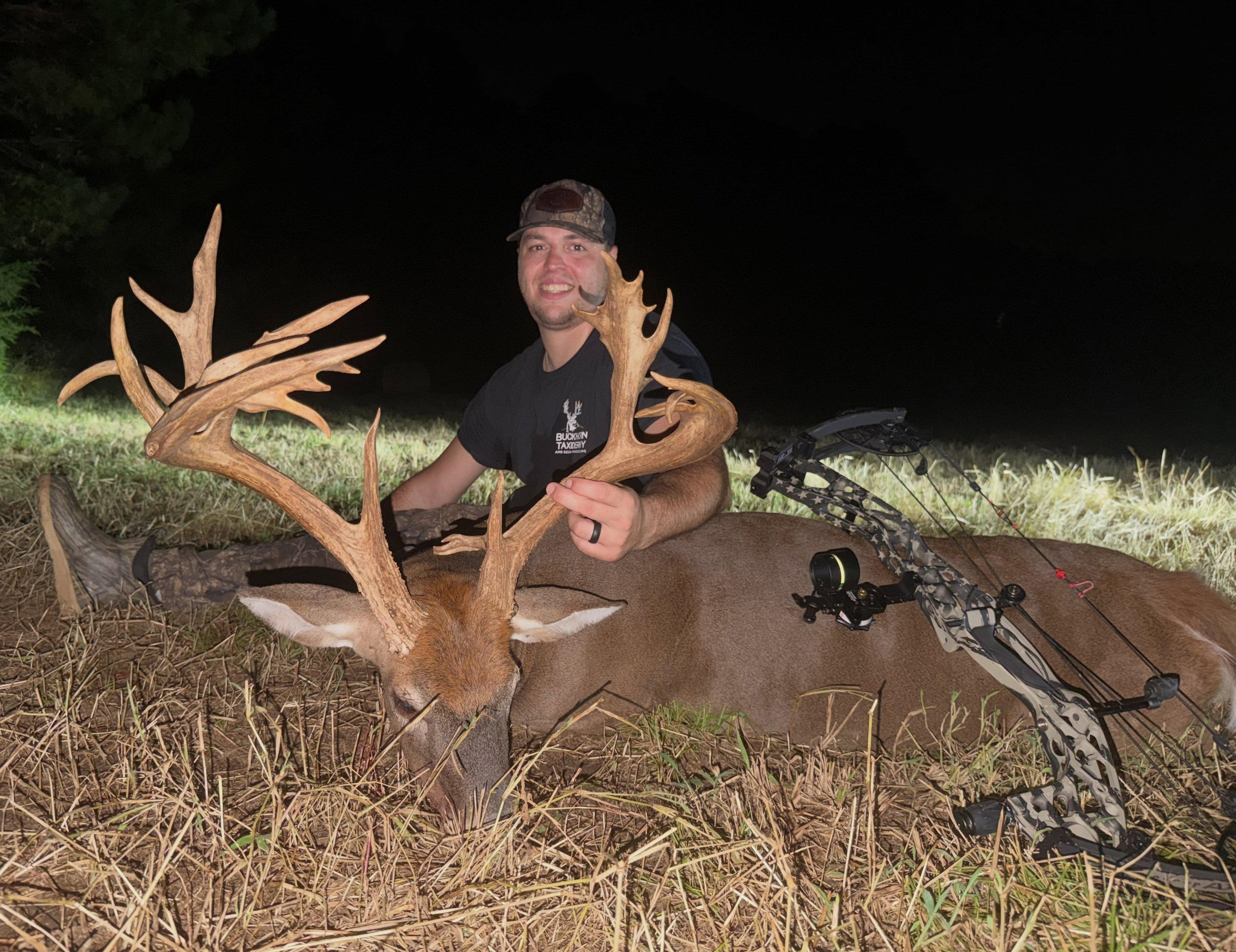
North Carolina bowhunter Graham Smith is all smiles behind his huge non-typical, which he had chased since 2022. Images courtesy of Graham Smith
When Graham Smith was a young child and his father and brother would go hunting, he’d stand at the door and scream as they left because he wanted to tag along. When he turned 4, his mother had enough of the tantrums and sent him off to the woods with his father and brother. And he loved it.
Two years later, at age 6, Smith bagged his first deer, a young 6-point buck. And he anchored it with a weapon very few deer hunters have ever used: a .410 bore with buckshot. His love for deer hunting only increased when he reached adulthood. Although he lives in a part of the country not known for big whitetails, he’s even been fortunate to bag a couple of Pope and Young-class bucks.
This year, his focus was on a world-class buck, which he’s been after since 2022. “He was at least 3-1/2 or maybe 4-1/2 that year,” Smith said. “He had a 7-point main frame with a sticker off the left G-2. The following year, he had an 8-point mainframe with a split G-2. He’s always had lots of trash around the bases and a flyer off his right G-2.”
Since 2022, Smith encountered the buck three times. The first time was in 2023, and the buck stayed out of range. In 2024, he saw the buck again, out of range, plus he’d already tagged out on bucks and was doe hunting. This past fall, he encountered the buck one more time, chasing a doe. Although the buck was within rifle range, he was bowhunting and watched the buck fade away. Smith has been strictly bowhunting for the last six seasons, and it’s a good thing he wasn’t toting a rifle that day, for his opportunity to bow-kill the buck was down the pipeline.
DON’T MISS: Wyoming Asks Hunters to Pass Collared Animals
That brings us to 2026. Smith had no shooter bucks on his trail cameras until he was on his way to Michigan for a coon hunting competition on Aug. 4. That’s when the giant whitetail first appeared on camera, and from that point on, Smith had his heart set on him.
“He came in daily around 7 to 7:30 p.m. to feed on corn,” he said. “We’ve been in a bad drought, and the crops didn’t do what they normally do. He was hammering the corn, and he’d stay for 40 minutes to an hour each evening.”
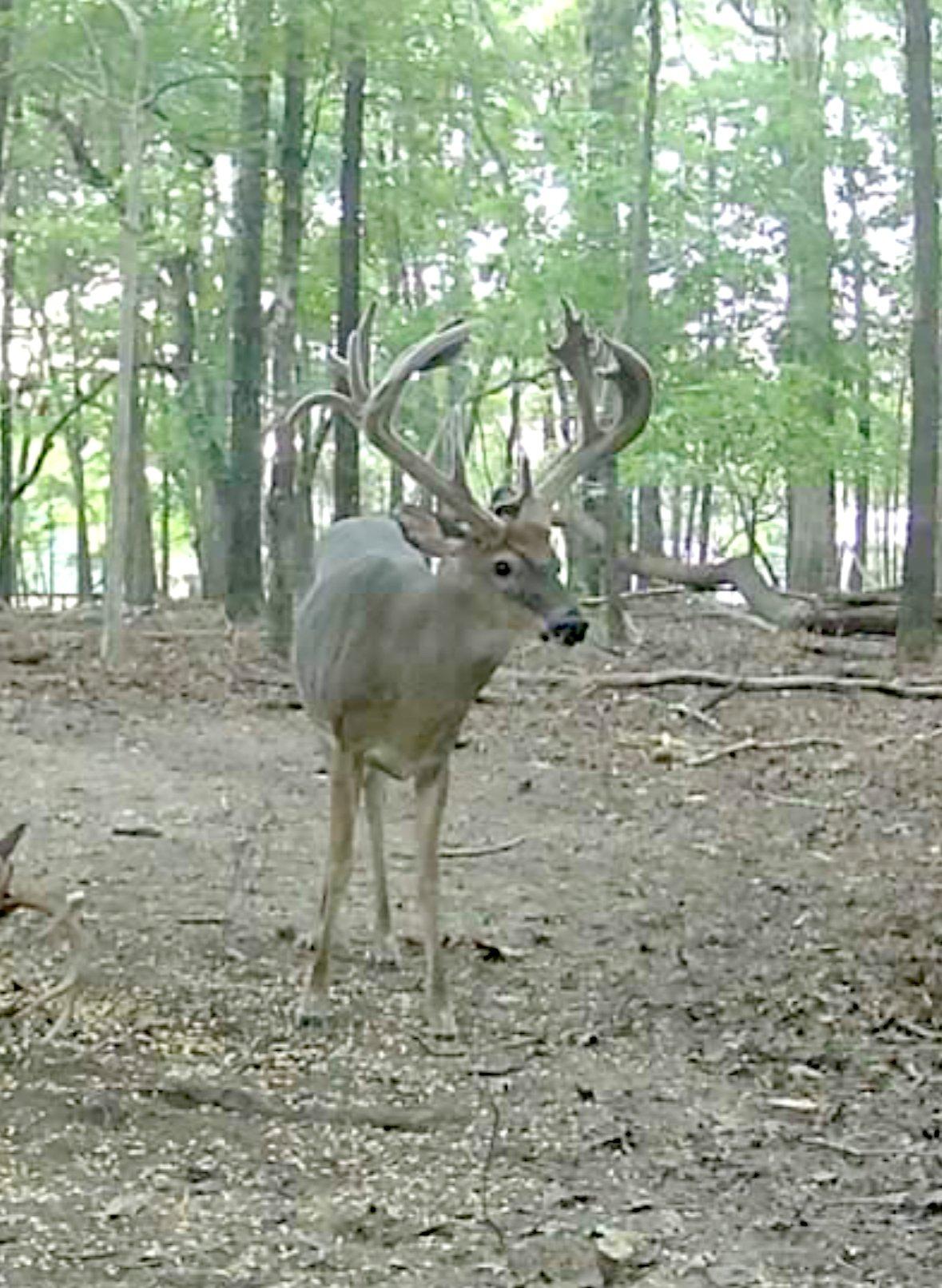
The buck was consistently hitting the feed and appearing in the daylight.
Given the buck’s evening routine, Smith hunted another spot near his house on opening morning. The buck appeared on the trail camera at 6:34 a.m. Obviously, Smith zoned in on that spot for the evening shift.
“It was a really good hunt for seeing deer,” he said. “I saw 13 deer, but I didn’t see the big one, so I considered it a bad hunt (laughs). That night, there were some bad storms, and he was on the trail camera at 11:30. The following morning, I hunted the same place I’d hunted the previous morning and didn’t have much action. I went to church and was contemplating whether to hunt at all that afternoon. The heat index was 104 degrees.”
Good thing he did. He arrived at the farm, and his trail camera went off at 3:30 p.m., capturing images of two does. When they left, he hustled to his stand.
“I got my Ozonics up and running,” he said. “Around 5 o’clock, a doe and fawn came in. I watched them for about 15 minutes. A little after that, a 3-pointer came in, and the doe and fawn took off running. The small buck fed for a while, and then the doe and fawn came back. When a 4-pointer came in, the doe and fawn took off again.”
The 4-pointer stayed on the edge of the baited area. Based on the young buck’s demeanor, Smith could tell the deer was sensing something wasn’t quite right, so he checked the wind. It had switched slightly, so he carefully adjusted his Ozonics.
“Just before 7, two does appeared,” he said. “I think they were the same two that had been in at 3:30. One bolted and the other came in. The other one came back but was really alert. Again, she bolted, but the other doe stayed and ate for about 20 minutes. Finally, she looked back toward a cutover that most of the deer come from, and she ran off. I figured a coyote was in the area.”
DON’T MISS: Shoot or Pass? The Riskiest Bowhunting Shots You’ll Face in the Whitetail Woods
Looking over his shoulder, Smith noticed two large-bodied deer. Immediately, he thought one of the deer was his target buck. He grabbed his bow and laid it across his lap.
“I finally saw his rack, and he was about 35 yards away,” Smith said. “I hooked my release into my D-loop. The buck moseyed to about 25 yards. The other deer, which was the buck that this one always ran with, circled an oak tree, and it seemed to make my buck alert. He looked like he was about to leave.”
The buck was quartered slightly toward the hunter, but given his diligent practice, Smith was confident he could make the shot. And he did. The broadhead clipped the heart and got the lungs, exiting the gut.
“He ran about 25 yards and fell over,” Smith said. “He got back up and bolted again. If I had been paying better attention, I probably would have seen him fall again.”
Smith called his wife to tell her the news. Next, he called his father, then his brother-in-law, and finally his taxidermist. After that, he got down and checked the arrow, which was covered in blood. Still, he left to meet several family members. The crew hopped onto a side-by-side and drove toward Smith’s stand location to begin tracking.
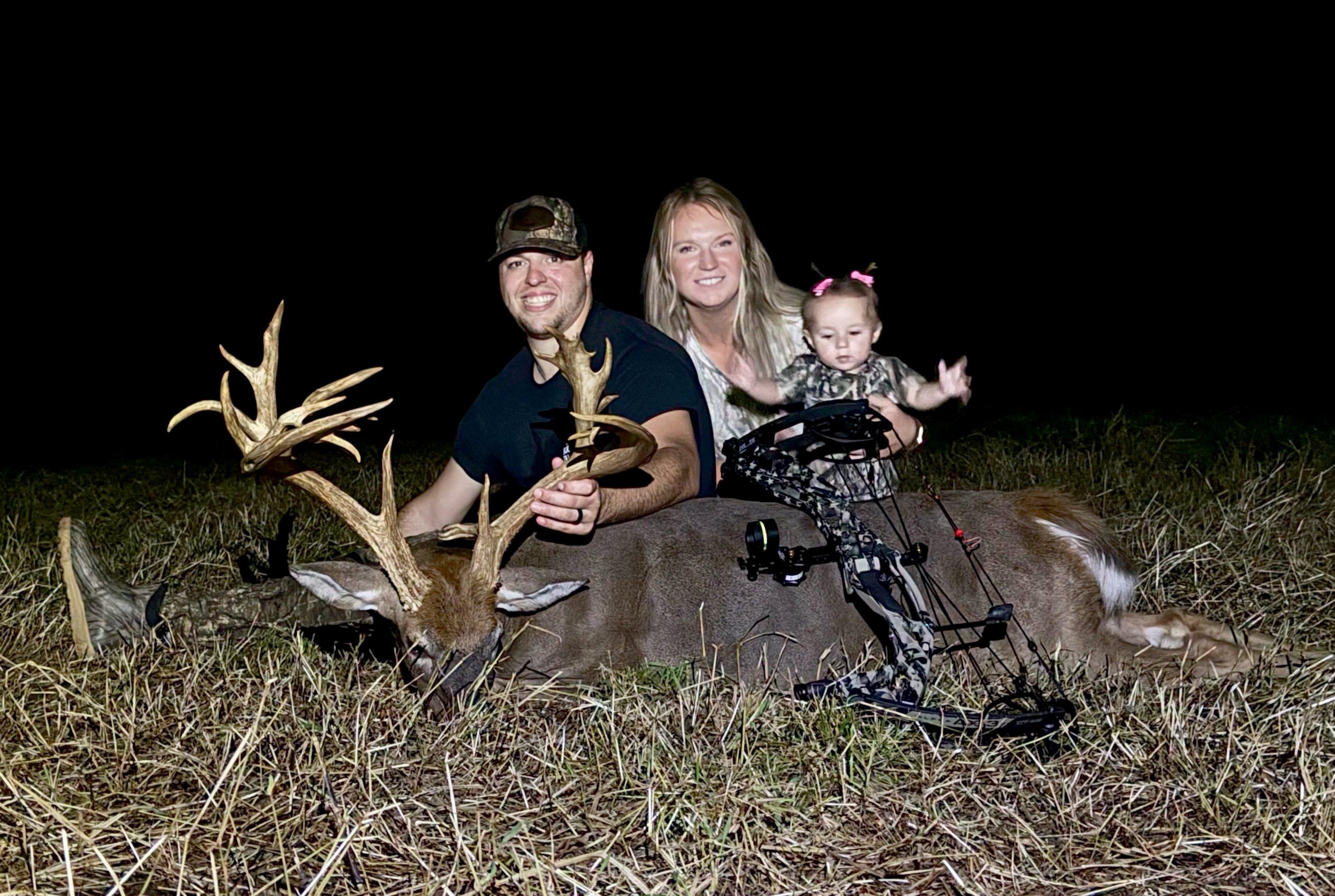
Smith’s wife, Sierra, and daughter, Parker Grace, joined in the celebration.
“We got on the blood trail but weren’t finding a whole lot,” Smith said. “I decided to follow a deer trail in the direction he had run, and I spotted him right away. He had only gone about 25 yards beyond where he had fallen the first time. The celebration began. I was jumping up and down, and I almost tackled my wife and my dad. I went and got my hands on him, and I couldn’t believe my eyes.
Check Out Our Latest Camo Pattern: Realtree APX
“Being a North Carolina guy, I always thought I would have to travel to Iowa, Illinois, Kentucky, or Kansas to kill a buck like this. To do it in my home state means so much to me. And the trail cameras truly did him no justice. I thought he was maybe in the 170-class. I had the rack officially scored by Buckmasters at 203-5/8. He has 11 points on his right antler and 12 points on his left. I still can’t believe it.”
If everything holds, after the 60-day drying period, the buck will become the new Orange County record and likely be in the top-five list of bucks ever harvested statewide.