How to Use Decoy Dogs for Coyote Hunting
Posted 2026-01-27 by
Decoying with dogs can bring coyotes right into your lap, and it's a great way to boost your success and effectively control the predators
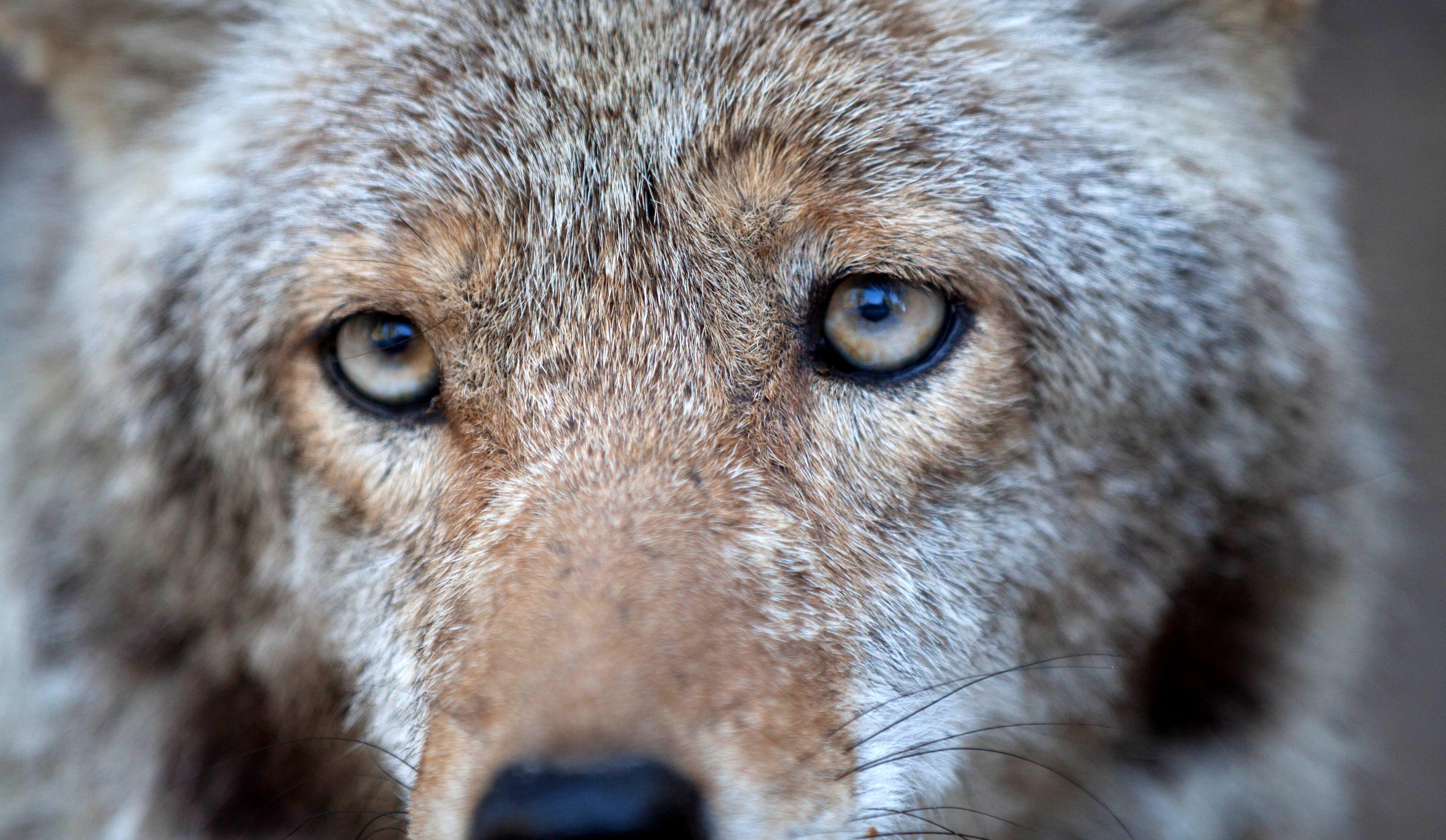
Most coyote hunters focus on winter, but managing coyotes in late spring and throughout summer, when livestock and wildlife are bearing their young, can reduce predation across the landscape. Image by Suzanne Wamp
Plenty of hunters enjoy calling coyotes during the off-season. Few hunters have ever tried using a decoy dog to increase their calling success, but it can be incredibly effective. Levi Johnson of Montana hunts coyotes with decoy dogs from spring through summer. He does it partly for the sport and for filming his show Doggin’ with Levi, but predator control is his chief motivator. “Outside of shooting them from a helicopter, I tell people that doggin’ is the most effective way to kill a lot of coyotes,” Johnson said.
Many aspects of doggin,’ as Johnson calls it, mirror traditional coyote calling. But a trained dog acts as a decoy to grab the responding coyote’s attention and then lure it into shooting range upon the caller’s command. Sometimes, it’s even within point-blank range. Johnson says that at certain times of year, multiple coyotes will respond, and it’s possible to get all of them because they’re so fixated on the dogs.
TIMING
Although coyote hunting with decoy dogs can potentially work anytime, Johnson said that summertime is hands down the best time of year. “It can work pretty well in May, but it gets really good in July and August,” he said. “At this time, both coyote parents are out of the den a lot more and teaching the pups to hunt. It’s a fairly easy time to call them out into the open, where the dogs can work them. Also, packs of one-year-old coyotes run around together at that time, and they’re kind of like cocky jake turkeys. They’re not very smart.”
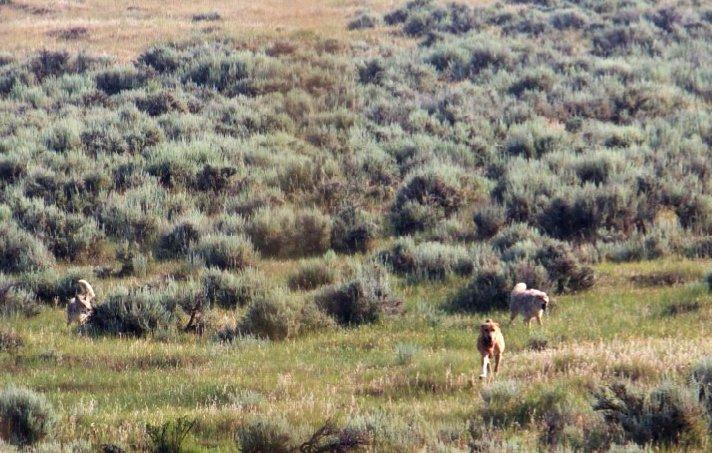
Using decoy dogs is an excellent way to draw coyotes in close for an exciting, up-close shot opportunity. Some setups produce multiple coyotes, as pictured here. Image courtesy of Levi Johnson.
Not only are coyotes more susceptible to decoy dogs during summertime, but Johnson said that summer is a more ecologically sound time to control their numbers. His grandparents were sheep ranchers, and seeing their struggles with coyote predation when he was younger was a big reason why he started hunting coyotes so seriously in the first place.
“Every year, they’d lose lots of lambs to coyotes. That bothered me,” he said. “When you’d go out and find eight dead lambs one morning that the coyotes killed the previous night, it was sickening and a big financial loss. What’s more, when the government trapper showed up, he killed the coyotes, but the damage had already been done.
Don’t Miss: How to Hunt Bobcats
“Not only are coyotes deadly on lambs and calves,” he added, “but they’re killing nesting turkeys and turkey poults, deer and antelope fawns, nesting birds, and grouse. Killing coyotes in the spring and summer does more good for the ecosystem than killing them in the winter. Go ahead and kill lots of them in the winter, too, but keep going in the spring and summer.”
TYPICAL DOGGIN’ SETUPS
When choosing calling locations (whether hunting with a dog or not), it helps to know where the coyotes are denning or at least spending a lot of time. Hearing coyotes yipping and howling or spotting them is a good way to scout. In late spring and early summer, you want to hunt within relative proximity of a den. As summer progresses, the male and female coyotes are teaching the puppies to hunt, and you can have successful setups in a lot more places.
Always know the wind direction before moving to a calling location. “We’re constantly asked if the wind matters when hunting coyotes,” Johnson said. “It is the most important thing. A coyote’s nose dictates everything it does. The wind has to be in your favor.”
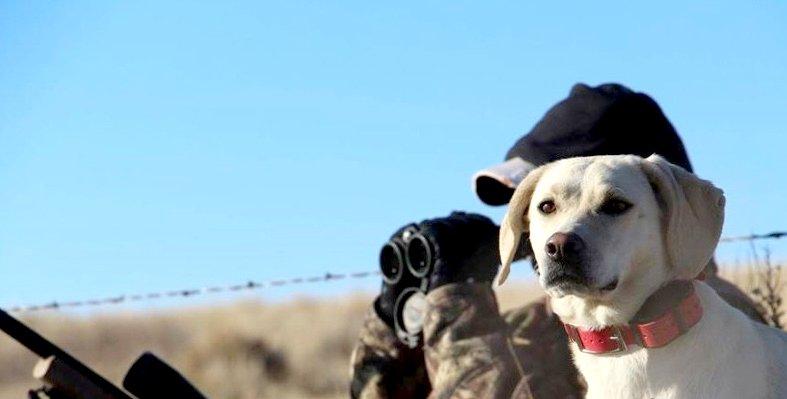
The dogs sit tight until a coyote is heard, smelled, or seen. Then, they run out to engage with the coyote. Image courtesy of Levi Johnson.
Once at his calling location, Johnson sets up against some sort of structure. Out in the West, that’s usually a cedar or some sagebrush.
“I set my FOXPRO caller 40 yards away and at least 30 yards upwind of my setup,” he said. “Every coyote that comes out will come downwind. My dogs are right by me while I’m calling. I begin the calling sequence with one lone howl. It’s a non-aggressive locator that basically says, ‘Here I am. Who else is around?’ When I do that, my dogs know that it’s time to start paying attention. I follow up with an electronic coyote sound on the FOXPRO so it sounds like two coyotes are talking. Then, I start glassing because the coyotes often pop up and are looking for the ‘coyotes’ they heard.
Don’t Miss: 4 Guns Every Coyote Hunter Needs
“If a coyote howls back, my dogs run in that direction,” Johnson continued. “They also run out if they see a coyote. But if I spot a coyote off in the distance, I wait a couple of minutes and begin a prey distress call. Out in the West, I like to use a fawn distress. I play it for two minutes and then shut it off. If the coyote is still hung up, I’ll play a pup fight or pup screams. The male and female get the perception that one of their pups has wandered in and is getting attacked by other coyotes. It triggers a parental instinct for a hung-up coyote to come in and save the pup.”
CALL IN THE DOGS
Once the dogs have acquired a coyote and engaged with it, Johnson said that it’s a back-and-forth exchange.
“They don’t usually fight one another,” he explained. “They’ll chase each other around for a little while, and at that point, the wind is somewhat irrelevant because the coyotes are so fixated on the dogs. They see the dogs as a potential threat and are basically trying to push them away. Once they’re fully engaged, I whistle the dogs back to me, and the coyote follows them. They might try to nip at one of the dogs, and the dogs will whip around and chase the coyote. Then, I whistle my dogs back again, and they come right to me. The coyote follows them right in, and we shoot it.”
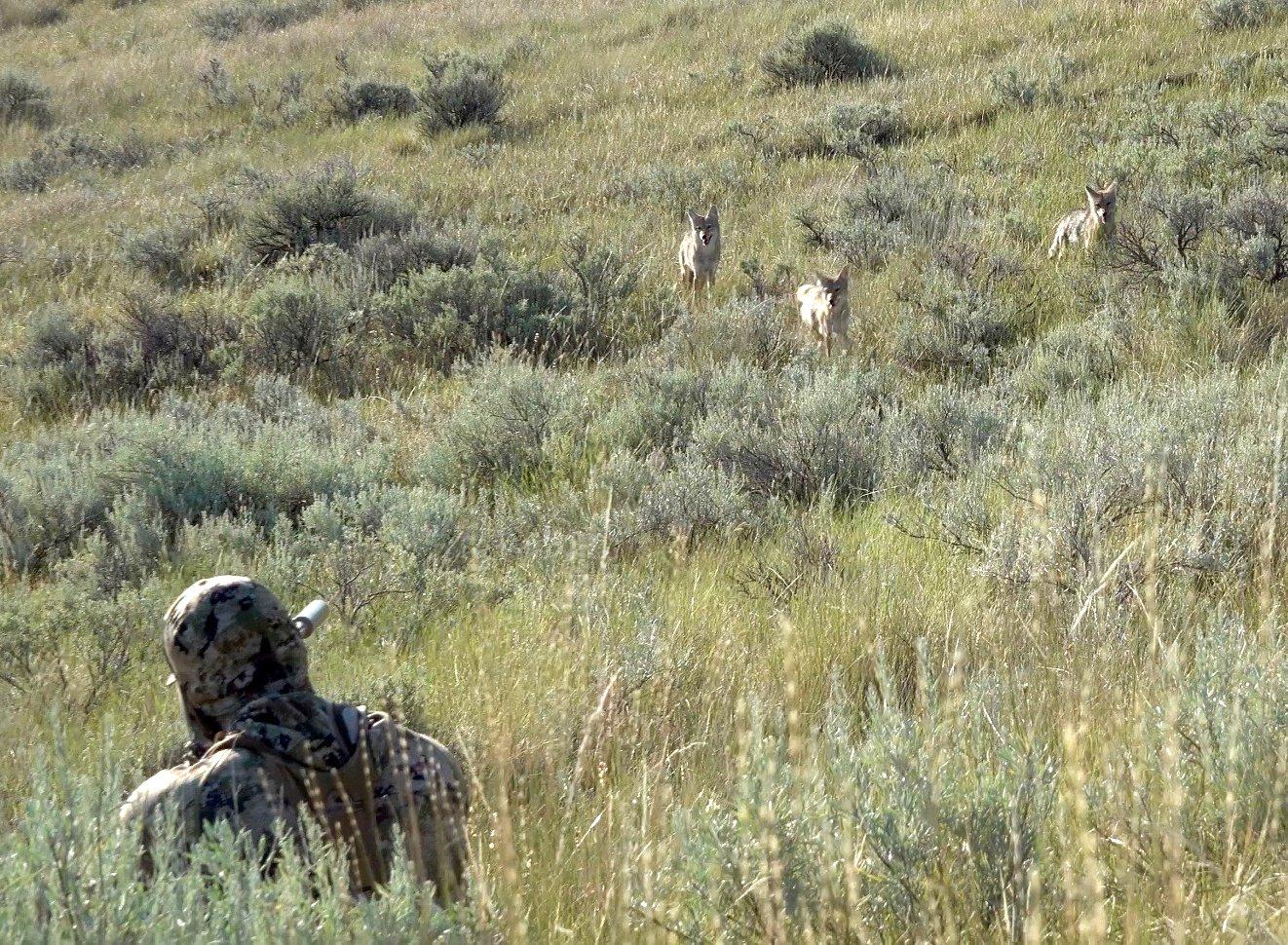
Although predator guns are capable of dropping coyotes at long range, just imagine how exciting it would be to have a coyote or three coming right down your gun barrel like this. Image courtesy of Levi Johnson.
The rifle’s report doesn’t necessarily signal the end of that particular setup.
“When we drop a coyote, the reward for the dogs is chewing on it,” Johnson said. “If other coyotes are nearby, they see the dogs chewing on the dead one and often come running in. They get so in tune with my dogs that it’s common to get doubles or even a few coyotes in one setup. This is the weakest point in a coyote's life. They can wind you and see you, but they just go right back to the dogs. When they’re so engaged with the dogs, they let their guard down. If we miss a coyote, we turn the caller back on, and the coyote often reengages with the dogs and offers a second opportunity.”
COYOTE DOG BREEDS
Any dog that can be trained to run out to the coyote, interact with it, and then be whistled back by the hunter can work for coyote doggin’. Johnson’s go-to breed is the mountain cur.
Don’t Miss: 10 Coyote Trapping Mistakes Beginners Make
“We love these dogs just like our kids,” he said. “We take great care of them. They’re such good family dogs. They’re not mean at all. I tell people that they’re labs with bobtails. We get asked about training dogs all the time. When we have puppies, we sell them at seven or eight weeks old. They need to bond with their new owners for several months. At 11-12 months old, they send them back to me, and I train them for two or three weeks. I take them out and let them go with my dogs that already know the drill. You never want to take out a dog on its own, especially one that has had little or no training, because coyotes can get pretty vicious and potentially injure your dog.
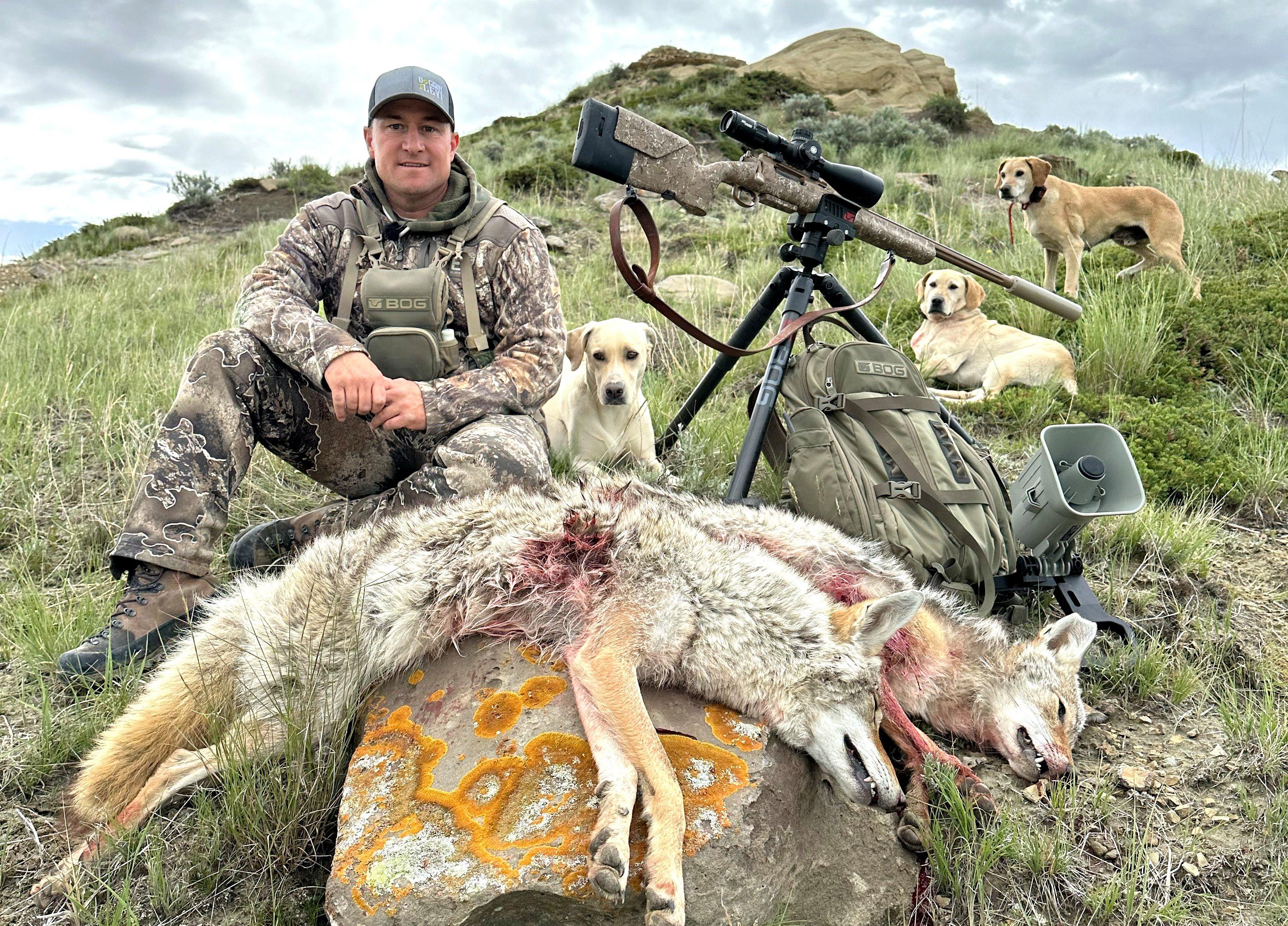
Levi Johnson and his mountain curs made short work of this coyote double. Image courtesy of Levi Johnson.
“After that initial training period, I send them back to their owners for a while,” Johnson continued, “and then I have them send the dogs back for a second go-around. It’s usually for a couple of months. After that, they’re good to go.”
Many areas across the country are overrun with coyotes, and strict management through trapping and hunting is the only hope for keeping them somewhat in check. Johnson has been hunting coyotes with decoy dogs since 2007. He often gets asked how many coyotes he has killed. “I’m not into that,” he admitted. “That’s not why I do it. What drives me to kill so many coyotes is knowing that we’re saving tons of livestock and prey species.”
To connect with Levi Johnson and learn more, visit dogginwithlevi.com.
In this action-packed video, Logan Sluggett of Doggin' With Levi folds a coyote decoyed into 41 yards using decoy dogs.