4 Amazing Wild Turkey Artists
Posted 2026-05-21 by
From paintings and decorative calls to intricate feather designs, these artists blend rare talent with a passion for spring turkey hunting
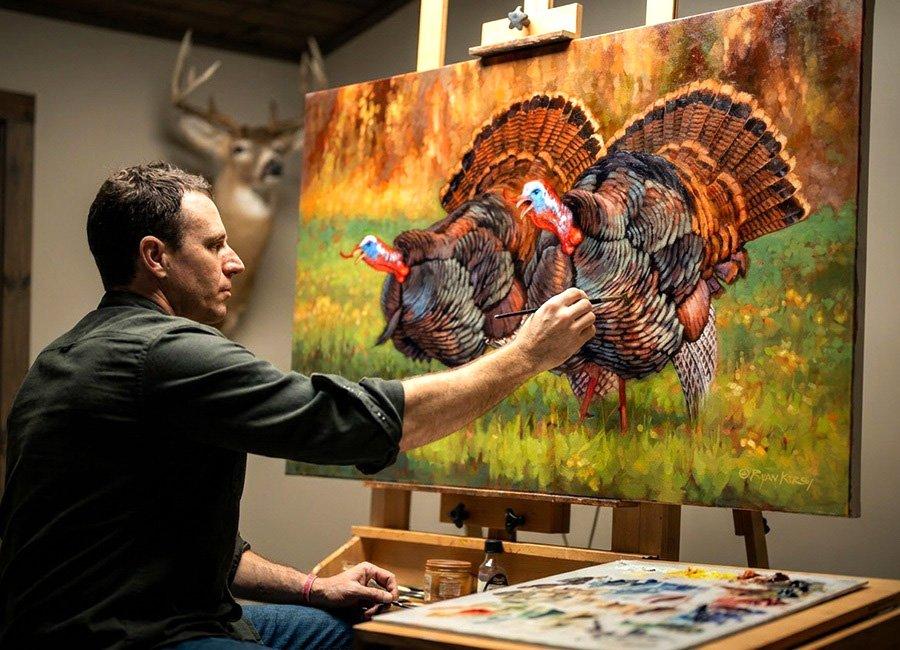
Ryan Kirby says authenticity is key when it comes to painting a wild turkey scene that resonates with hunters. (Photo provided by Ryan Kirby)
The wild turkey may seem like an unlikely muse for some artists, with its bald head and gaudy behavior. But for others, particularly artists who love turkey hunting, the wild turkey is emblematic of springtime beauty and incredible memories. The work done by the artists profiled here is inspired as much by early mornings in the woods and thundering gobbles as it is by time in the studio. As such, their work resonates deeply with fellow hunters, with creations that capture the spirit of the hunt.
PAINTINGS | RYAN KIRBY
Ryan Kirby’s stunning paintings capture not only the intricate detail of a strutting tom, but the feeling of being there, at eye level, in the woods. Kirby is a die-hard turkey hunter who says authenticity is integral to his work, and is what sets it apart. He doesn’t just paint turkeys; he paints moments that hunters instantly recognize. His paintings have earned a variety of awards and have been featured on numerous magazine covers including Outdoor Life, Field & Stream, Turkey Country, and Fur-Fish-Game.
Kirby says his connection to the land and the animals that live on it began in a small farm town in western Illinois, where he grew up surrounded by cornfields in a community of about 3,000 people.
“I was a farm kid,” he said. “I grew up around livestock and fishing in farm ponds. I also had a passion for hunting.”
He and his dad enjoyed hunting a variety of game together during his early childhood, and when he turned 10 years old, they decided to try turkey hunting. “We had never turkey hunted before, so we just figured it out together,” Kirby said.
The process forced Kirby to pay close attention, building the observational skills that would later define his artwork. That attention to detail carried into his art early on, encouraged by a high school art teacher who recognized his natural talent. Kirby’s artistic career got a boost at 16 when he won the National Junior Duck Stamp Contest, putting his name on the map and leading to early commission work. While still in high school, he balanced painting hunting dog portraits with bailing hay.
Eventually, he was able to use the combination of artistic skill and hunting knowledge for a job with the National Wild Turkey Federation, where he spent several years honing both his design and illustration abilities. Even then, Kirby never stopped painting, and he made the leap to a full-time, self-employed artist in 2010. He says his blue-collar mindset, shaped by his upbringing, carried him through years of balancing commercial design work with wildlife art.
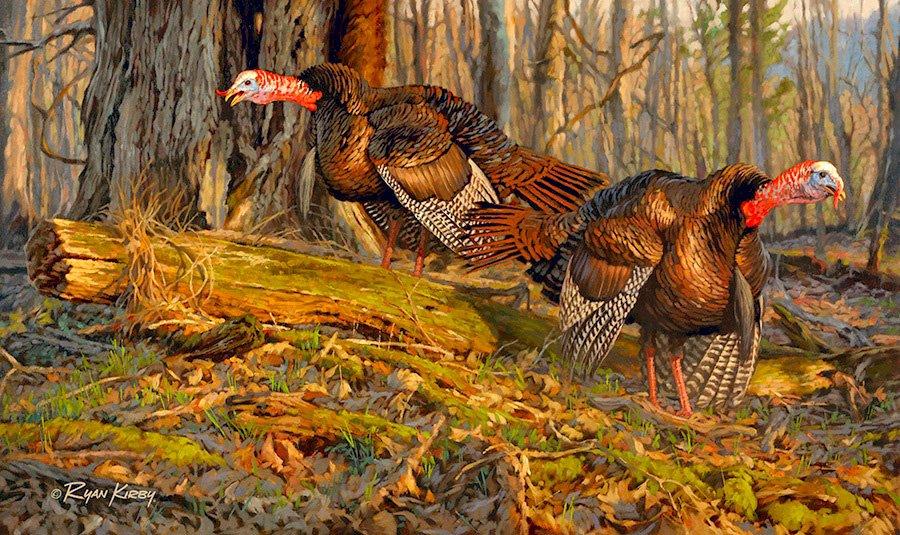
Ryan Kirby paints more than just turkeys — he paints moments that hunters will recognize. (Photo provided by Ryan Kirby)
Kirby has always especially loved painting turkeys, which he finds endlessly fascinating. As a teenager, he would head into the woods out of season with a decoy and a push-button yelper, calling birds in just to watch, photograph, and film them.
“The thing I love about turkey hunting is that everything takes place at eye level on the ground,” Kirby said. Those up-close experience give him an accurate perspective as an artist, and that has helped him to recreate scenes not just from reference, but from lived experience. Still, he says painting a turkey scene that resonates with hunters can be difficult. “Turkey hunters are die-hard,” he said. “You can’t fake it. You’ve got to understand the animal, the habitat and the behavior. They know intuitively if something is not right with your painting.”
Today, Kirby approaches each painting with a mix of creativity and precision, often starting with an idea pulled from something he’s seen in the field.
“Every brushstroke is a decision on what color, what hue, and what value to use. It’s very precise. Usually, after I’ve been painting for about six hours, I’m toast.”
Kirby’s goal is for his work to resonate with hunters and to be treasured by future generations of hunters and non-hunters alike. “I want to create something meaningful enough to hang in a home, spark conversation in a hunt camp, and maybe even be passed down to the next generation,” Kirby said. “I am fortunate to get to do what I love and nothing makes me happier than to be able to create a piece of art that people will want to pass down to their children.’
FEATHER ART | JEFF FREDRICK
Jeff Fredrick’s art started in his father’s Wisconsin taxidermy shop, where he grew up in the 1970s through the 1990s. That environment gave him a rare, hands-on understanding of wildlife and introduced him to hunters from across the country, including some southern turkey hunters who helped spark his early interest. Before long, that interest turned into a passion that would shape both his life and his art.
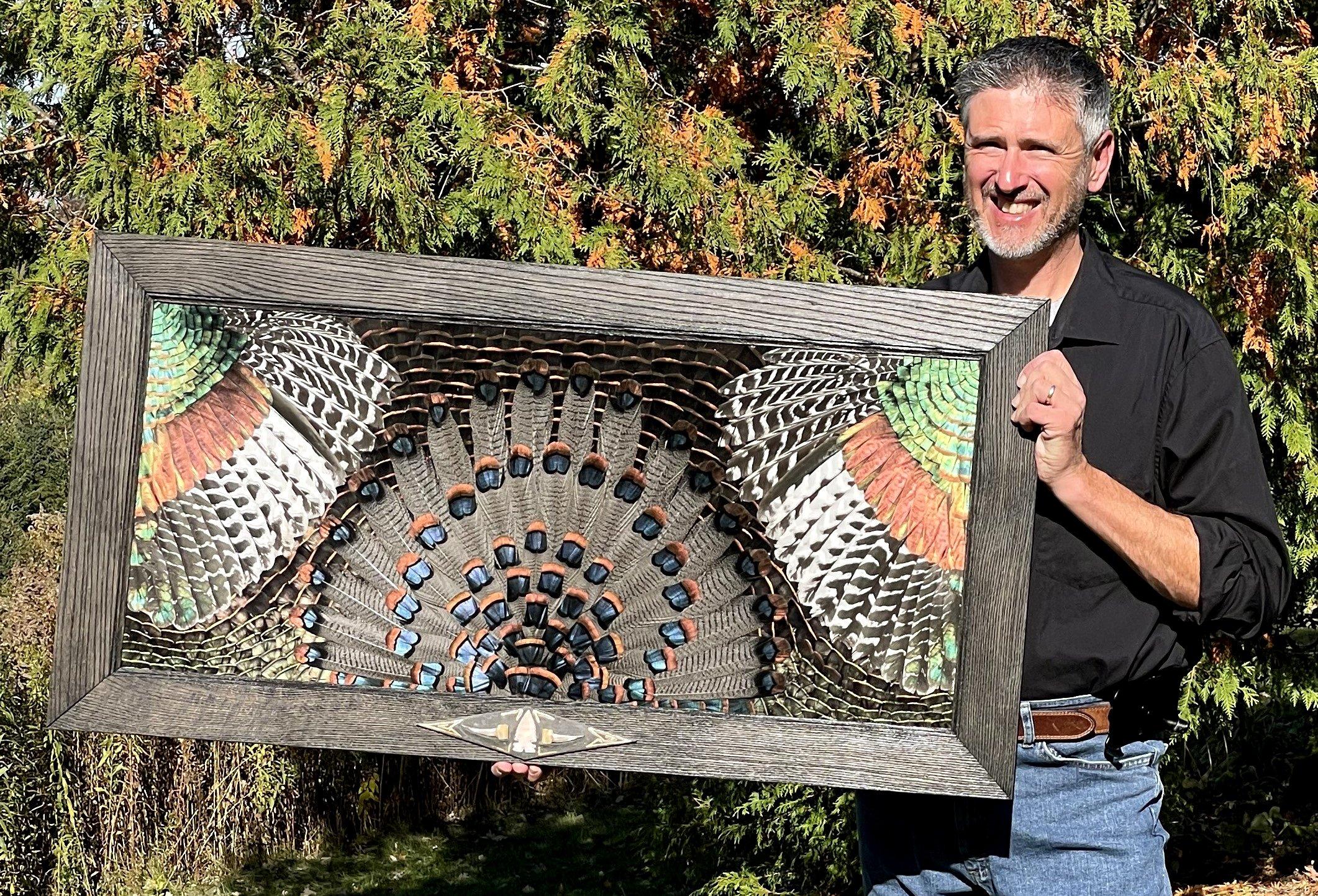
Initially created to fill wall space at an art gallery, Jeff Fredrick’s feather art is now in high demand from hunters around the country. (Photo provided by Jeff Fredrick)
Fredrick’s connection to turkeys first took hold through hunting and calling competitions. After buying his first mouth calls at the Madison Deer Classic, he quickly found success, winning his first calling contest in 1988 and eventually earning 12 Wisconsin state championships along with national-level accolades.
Like his father, he had creative talent but he decided to build a more traditional career path, studying commercial art and working as a graphic designer and art director at a sign company. He balanced life behind a computer while also spending time in the woods and on the calling stage.
Don’t Miss: Crispy Wild Turkey Citrus Stir Fry
Eventually, Fredrick felt the pull to create something related to his love for turkey hunting and calling. Inspired by his father’s craftsmanship and the work of famed wildlife oil painter Owen Gromme, he left the sign company to pursue art full-time. Like many artists, Fredrick had to get creative to make it work. He built and sold turkey calls and decoys at sports shows alongside his oil and acrylic wildlife paintings. The turning point came when he began experimenting with real turkey feathers while building decoys.
“I noticed the cool patterns and the iridescent feathers. I thought they were beautiful,” he said.
That curiosity led him to create abstract feather pieces that he initially designed just to fill wall space at a gallery show. But people really liked what they saw and the response quickly grew. By 2019, his feather art was gaining serious attention online. And today, Fredrick’s process is as distinctive as his finished pieces. Many of his materials come directly from hunters, who send in turkeys to be transformed into art. Drawing on techniques he developed over years of working with decoys, he carefully prepares each piece, keeping feather groups organized so their natural variation remains intact. He builds each composition by hand, while maintaining a growing backlog of orders.
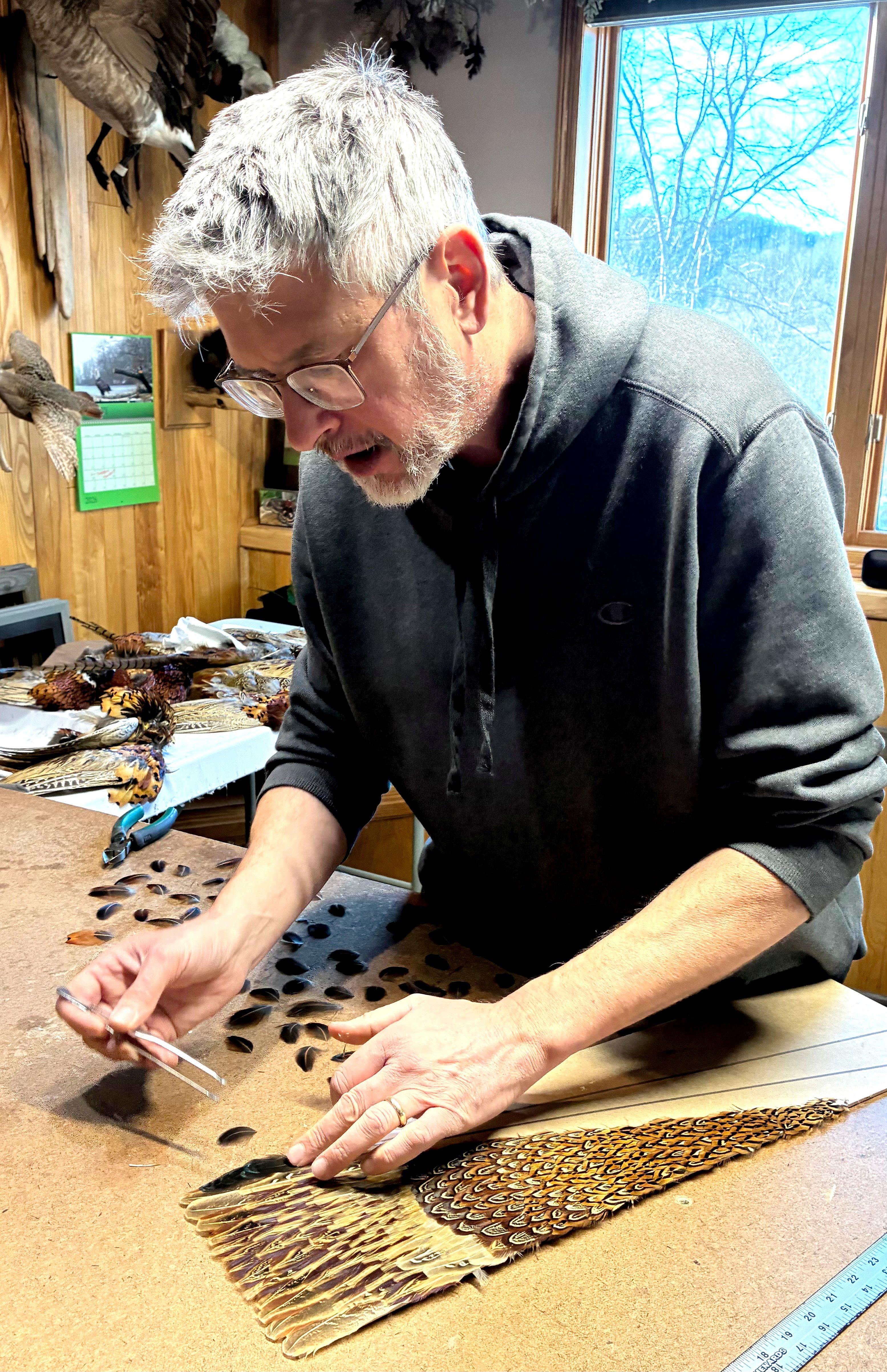
Fredrick works tirelessly to ensure his feather art arrangements reflect each bird's individuality. (Photo provided by Jeff Fredrick)
“I developed a method for skinning a turkey that keeps the feathers from getting bloody and mixed up. My customers use my method, which I’ve posted to YouTube, to skin their turkeys before sending them to me,” Frederick said. “In order for the process to work and to get all of the sections done the way I want them to look, I need the feathers in context. Each group of feathers has different characteristics. The feathers on the top of the chest are different than the feathers on the bottom of the chest, which are different from the feathers on other parts of the bird.”
He also says it doesn’t work when a customer tries to send him a tail feather or two from another bird to replace a missing tail feather on the main bird.
“There’s just too much difference from bird to bird to make it work and look right. No two turkeys have the same pattern,” he said. “There is almost as big of a difference in feather patterns from bird to bird as there are species to species.” That makes every piece Fredrick creates unique. And that resonates deeply with hunters, who know that every gobbler called to the gun is also unique.
“My hope is that my customers will get to enjoy years and years of beauty from my work. Regular taxidermy often gets donated or discarded after the hunter passes away because the mount is typically only special to the person who shot the animal. But my pieces are artwork that those who didn’t harvest the bird can also appreciate, and my pieces will hopefully be passed down for generations.”
DECORATIVE CALLS | TIM OLDHAM JR.
Tim Oldham Jr. has always had a passion for the outdoors, but his love of turkey hunting has directed his life’s path. He grew up in the creek bottoms of southern Indiana, and while he was introduced to deer hunting at a young age by his dad, it wasn’t until high school, when a friend took him turkey hunting for the first time, that everything changed. “When I shot my first bird, that started the fire,” Oldham said.
Tim Oldham Jr. has won numerous awards for his beautiful hand-carved decorative calls. (Photo provided by Tim Oldham Jr.)
The new obsession eventually shaped not only how he spent his time in the spring woods, but also how he expressed himself as an artist. Oldham had always enjoyed working with his hands, and in 2003, he started crafting turkey calls as a hobby. Soon after, he began painting designs on the backs of pot calls to make each one unique. He began selling his painted calls on eBay, slowly building a name for himself, and in 2005, he entered his first National Wild Turkey Federation Decorative Call Competition. The positive response was immediate.
“I was blown away,” Oldham said. That early success revealed a platform where he could combine his love for turkey hunting with his talent for creating turkey calls.
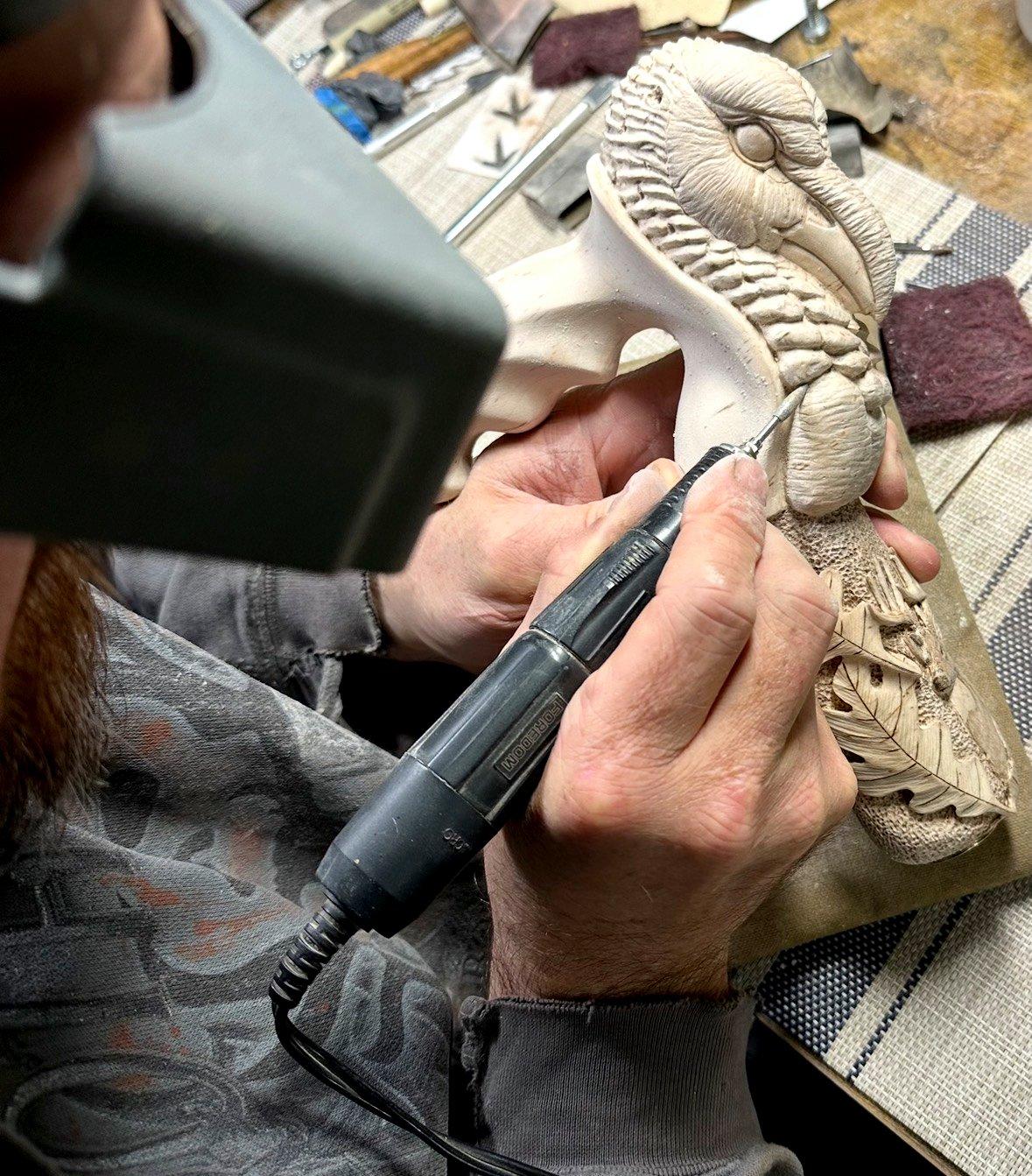
As his skills grew, so did his ambitions. Oldham began carving as well as painting turkey calls, teaching himself through trial and error before connecting with local carver Ken Alvey, who helped him refine his craft. Alvey even built a facility where carvers could hang out and learn from him. From there, Oldham’s work took off. Over the years, he’s earned numerous awards including multiple world titles and the prestigious Earl Mickel Award (Best of Show) a number of times. He was also inducted into the NWTF Custom Callmaking Hall of Fame in 2023. But behind every piece is a deep investment of time and effort.
“If you’re going to win at that level, you’ve got to put the time in,” Oldham said, noting that some of his most detailed works require 250 to 400 hours to complete. The inspiration for them almost always comes from the woods, an idea or a moment that he’s seen or experienced while hunting that sticks with him and gradually takes shape.
“I’ll see something and it just stays in my head,” he said.
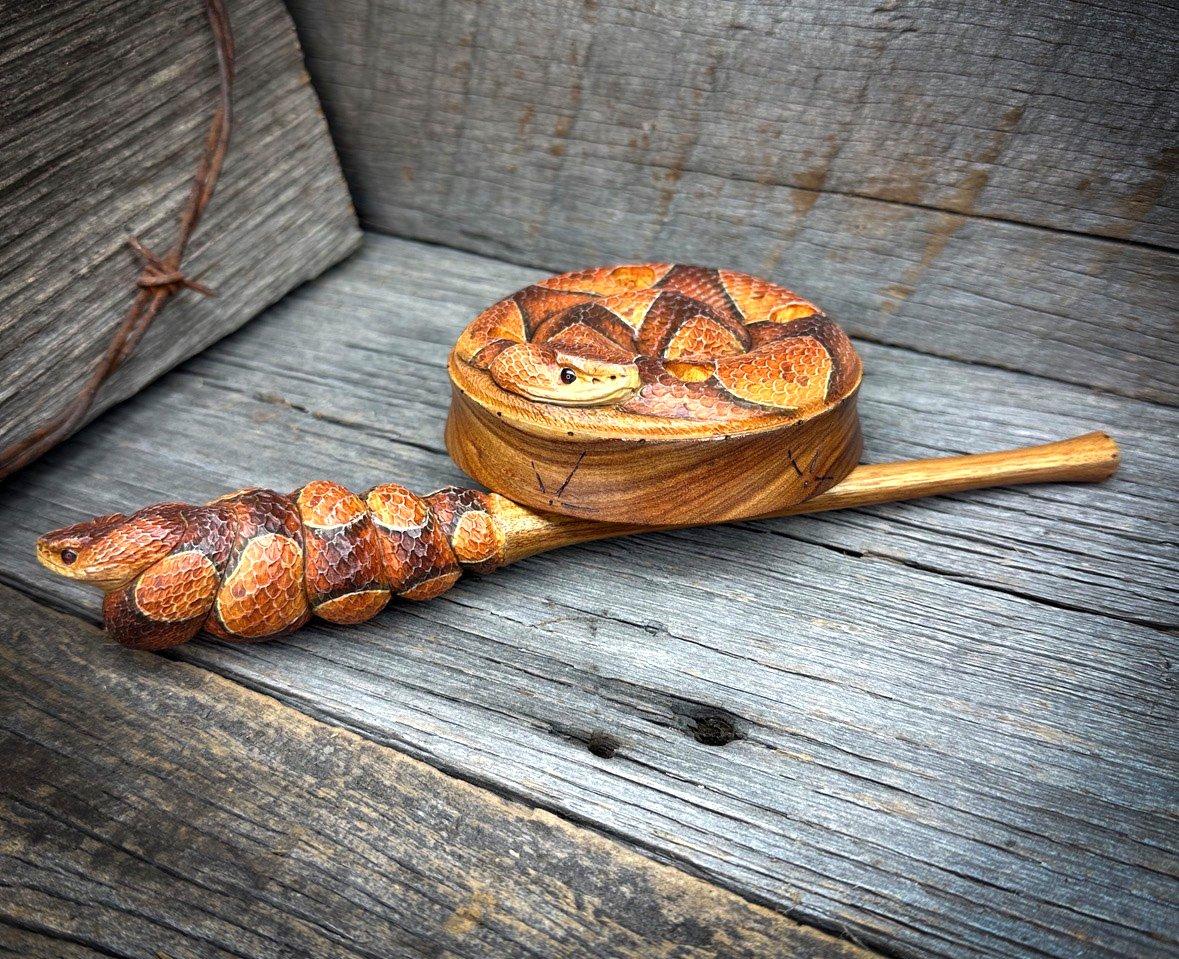
Some of Oldham’s detailed works require hundreds of hours to complete. (Photo provided by Tim Oldham Jr.)
One such piece, titled Mother’s Love, was inspired during a difficult time when his wife was ill.
“During that time, I decided to refocus my priorities on spending time with the people I love. That year, for me, was about my wife. We were sitting together watching birds at a feeder from the couch. I started reflecting on my family and priorities, which led to the creation of a carving featuring a hen turkey and her poults under her wings. That one meant a lot to me.”
Don’t Miss: 4 Types of Turkey Gobbles (And What They Mean)
Today, Oldham’s handcrafted calls are both functional tools and intricate works of art, often with a waiting list stretching years. While the awards helped establish his name, they’re no longer his primary motivation. “It’s not about the awards anymore,” he said. Instead, knowing his work connects with other hunters is the driving motivator. “Every piece I do will outlast me,” he said. “I want a piece of me to live on through my art.”
FEATHER SILHOUETTES | RANDEE “BEAR” SMITH
Randee “Bear” Smith is a full-time artist in Northern Wisconsin whose work centers on transforming repurposed feathers into detailed wildlife silhouettes and nature-inspired artwork. Through her business, Bear’s Wild Creations, she aims to create beautiful and meaningful pieces.
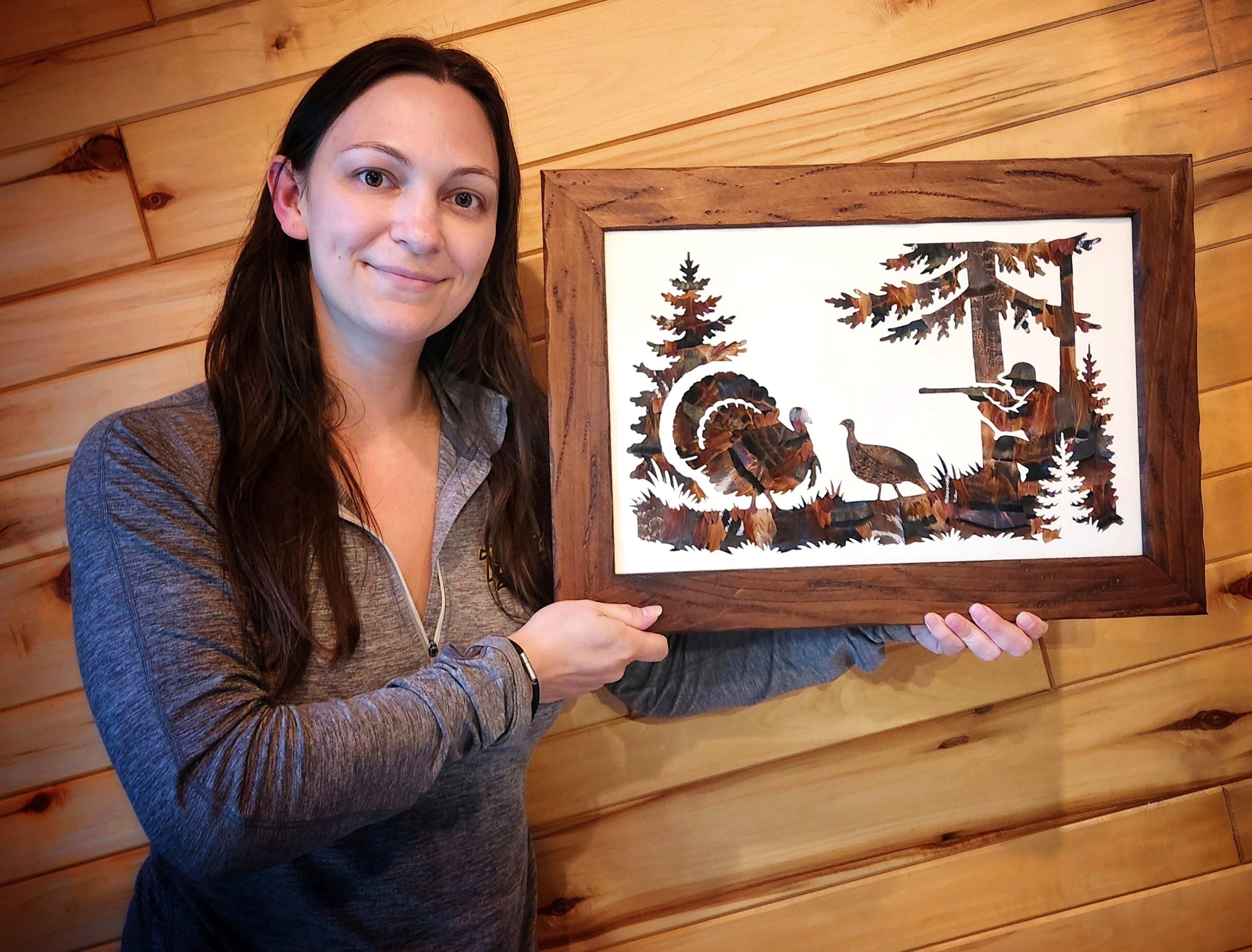
Randee “Bear” Smith creates beautiful wildlife silhouettes and nature-inspired art from repurposed feathers. (Photo provided by Randee “Bear” Smith
“At the heart of it, I’m creating keepsakes for people who have a deep connection to the outdoors,” she said. “Feathers are how the story gets told.”
Her work is especially popular among hunters, including those who want to preserve memories tied to turkey hunting. Smith’s journey as an artist began in 2020 after she got her first bird dog and started noticing how many beautiful feathers were left behind after hunts. She hated seeing them go to waste, and what started as a simple effort to repurpose them quickly turned into a creative outlet. She began building layered silhouette designs, using feathers as texture and color to bring outdoor scenes to life in a way that feels both natural and artistic.
A major part of Smith’s process involves working directly with the hunting community. She collects feathers herself or receives them from fellow hunters who want their harvests to carry deeper meaning. She does not buy feathers, and instead relies on repurposed materials that already hold a story.
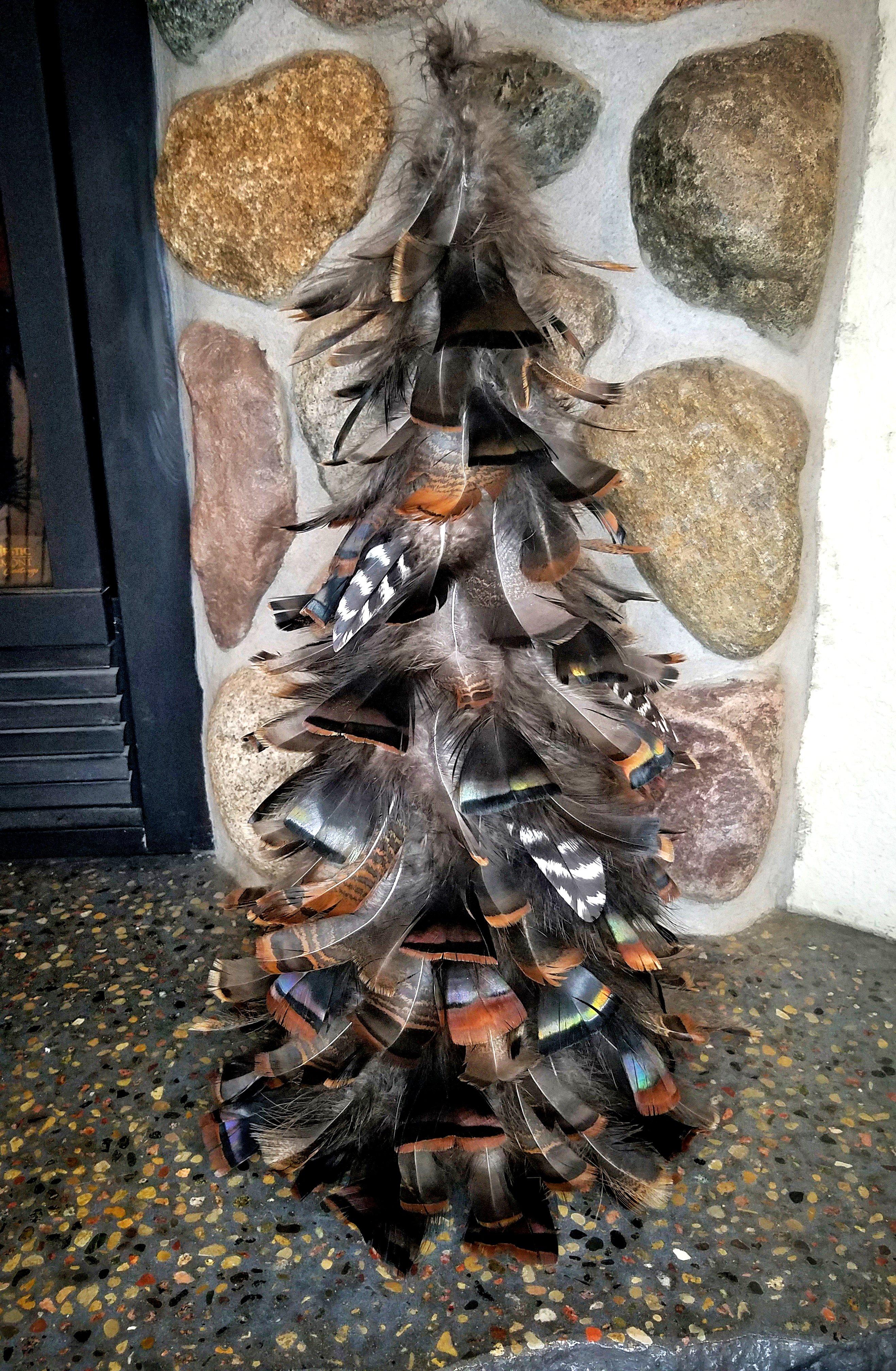
Smith said being able to turn feathers from a customer’s hunt into art that can be treasured for years to come is incredibly special. (Photo provided by Randee “Bear” Smith)
“Most meaningful is when customers send in feathers from their own hunt,” she said. “It’s a way to commemorate the bird and tie it back to the experience.” Smith works with feathers from different types of birds, but turkey feathers are a key element in many of her designs. She says they require careful handling because of their larger size and complexity. Each piece is made to order, with feathers sorted, trimmed, and arranged by hand to create layered silhouettes with depth and movement. Smith often combines turkey feathers with those from other game birds to achieve the right texture and detail.
“No two pieces are alike,” she says, emphasizing the natural variation in every bird.
As her work has grown, Smith has expanded into wreaths, ornaments, and functional home décor, while also offering custom designs that often incorporate a customer’s own feathers. Much of her business now reaches customers across the country through social media and Etsy. For Smith, the goal is always to preserve meaning.
“It’s not just about a harvest,” she said. “It’s about traditions and memories outdoors. Being able to turn feathers from my customer’s hunt into art that can be kept and displayed for years is incredibly special, and it’s a direction I’m excited to continue growing in through both my current work and new ways of displaying them.”
These artists all capture the beauty and mystery of the wild turkey with their own unique talents — but it’s a passion for the hunt and appreciation for wild birds that really makes their work stand out, and no doubt be passed down and appreciated by turkey hunters for generations to come.