How to Tie 3 Easy Fishing Leader Knots | Videos
Posted 2025-12-19 by
If you need to tie on a leader for just about any fishing purpose, then check out these easy-to-follow videos
Braided line has revolutionized fishing since it became popular in the early 1990s. With an incredible strength-to-diameter ratio and durability that lasts countless trips, braid is the choice of many freshwater and saltwater anglers. Today, it’s likely that braided lines are used more than any other type, especially for a mainline.
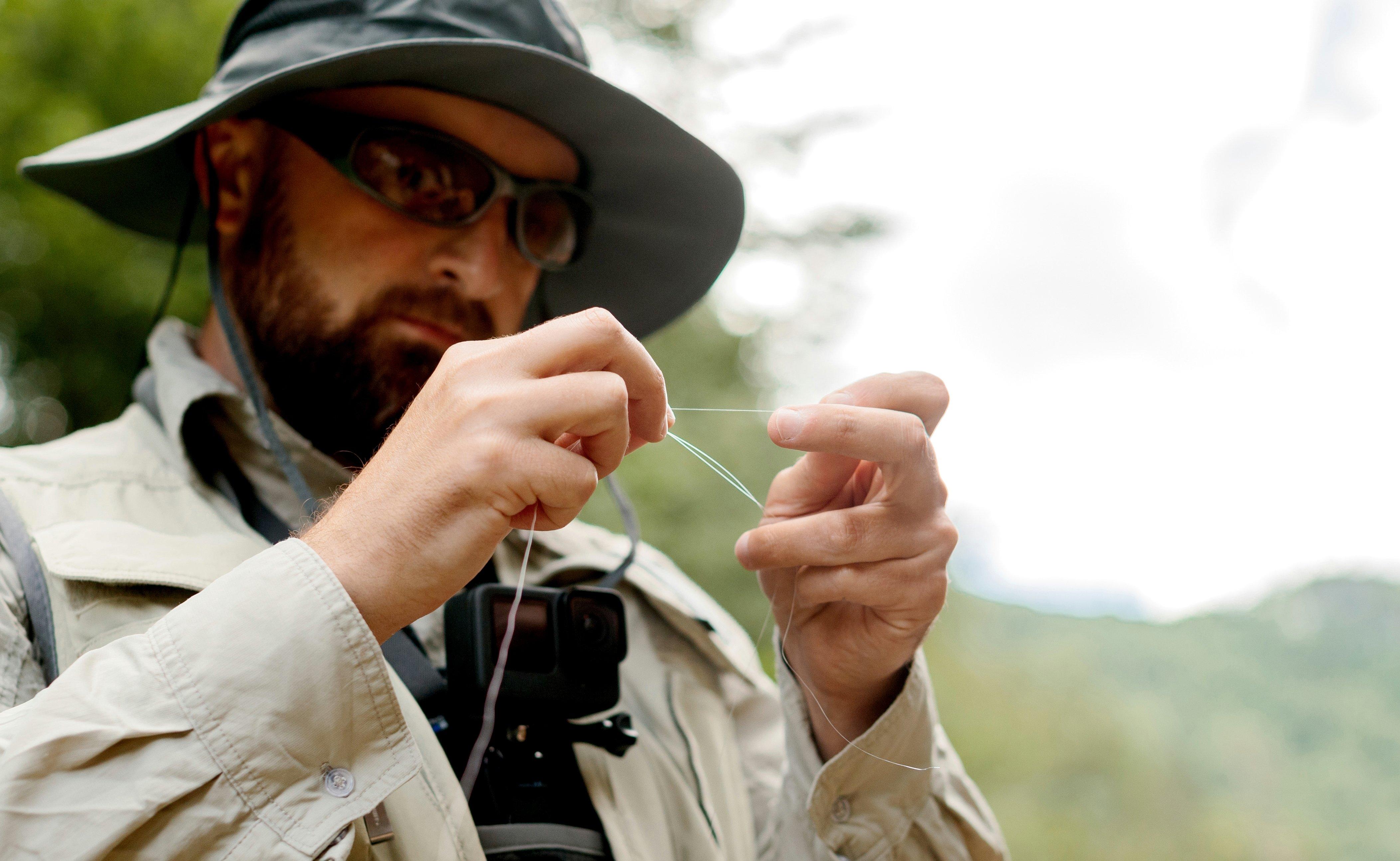
Need to join two lines, or a line and a leader, together? These are the knots to learn. Image by Dymtro Sheremeta
But for many fishing presentations, braided line works better when paired with a leader. Sometimes you need a monofilament leader to prevent killing the action of a particular plug, or a fluorocarbon leader to resist abrasion and fool the eyes of wary fish in clear water. Often, it’s good to have a leader in snaggy situations to keep from breaking off an entire setup. And sometimes, you need a leader even when you’re not fishing with braid, say when you need to connect a heavy monofilament mainline to a lighter leader.
Regardless of purpose, every angler needs to know how to connect leaders to mainlines with proper knots. Some knots, like the old-fashioned blood knot, are easy to tie. But for other presentations, a more complex union must be made.
These three common knots are all used to connect mainlines to leaders, and they will get you through just about any fishing scenario. Included are instructional videos to help you get the hang of tying each of them.
THE BLOOD KNOT
The blood knot is a fast, easy way to join two similar types of fishing line.
The blood knot is the oldest knots in the books for joining two fishing lines. It’s actually two clinch knots tied back-to-back, resulting in a relatively small profile junction. A good leader knot must have a streamlined shape and the ability to pass through rod guides. The blood knot fits that profile. The tag ends stick up a little, requiring a close nip with sharp cutters.
Blood knots should be used only when tying two similar lines together, say 12-pound mono to 20-pound mono. Braid-to-braid works well here, too. Never attempt to use a blood knot to tie two different line types (braid to fluoro etc.) or very different diameter lines.
Basically, lines are overlapped, the leader is wrapped 4-6 times around the mainline, a loop is held at the starting point, then the mainline is wrapped the same number of times around the leader. Both ends are then pushed back through the starting point loop from opposite sides and the knot is pulled tight.
It’s best to concentrate on pulling the main portion of the lines, rather than the tag ends, for most of the cinching with a blood knot. A blood knot is great if you need to join lines quickly as the result of a tackle failure or for a quick, temporary line adjustment.
Don’t Miss: ALL ABOUT BAITFISH
THE DOUBLE UNI-KNOT
The uni-uni knot is a strong, quick way to connect two different types of line
The uni-knot is often credited to saltwater great Norman Duncan, though a few sources claim the knot has been around for generations. The concept is simple: the tag end of the line goes through the eye of the hook, runs back parallel to the main line and is looped. From here, wraps are made within the loop around the mainline and original tag end. When pulled tight, the loop essentially “knots” the loops.
A double uni-knot, sometimes called a back-to-back uni-knot, or even a uni-uni, simply uses one uni-knot to tie to the other. This is an effective knot to join different types and sizes of line. A good example would be connecting 15-pound braid to a 12-pound fluoro leader. Or 65-pound braid to a 15-pound mono. The knots are effectively independent of each other, allowing any lines to be joined.
To tie, lines are overlapped. A uni-knot is tied to each side, and both can be somewhat configured and tightened before the juncture comes together. To do so, pull on the mainline and leader after wetting.
The downside of the double uni-knot is lack of strength. It’s plenty strong to handle a bass or trout, but forget a double uni-knot for hard pulling fish like grouper or big catfish. There, the knot will essentially cut into itself and break-offs are commonly the result.
Don’t Miss: FIND A FALL CRAPPIE BONANZA IN FALLING WATER
THE MODIFIED ALBRIGHT KNOT
The modified Albright knot is a great way to add a heavy leader to your main line.
There are several Albright knots out there and a few modified versions. The concept remains similar in each: a thin mainline cinches down around a thick leader line, often much thicker than the mainline. The knot is usually credited to legendary Florida Keys guide Jimmy Albright.
The knot became all the rage with the expansion of big-game saltwater fishing. Here, leaders may surpass 100-pound test, featuring massive diameters that are difficult to cleanly connect to thinner mainlines. The Albright knot solves that problem by utilizing a principle where a braided mainline is wrapped in a way that it cinches down and shrinks when pulled, similar to a Chinese finger trap toy. Inside is the large leader, and it’s not getting loose.
Because the mainline essentially “holds” the leader, the Albright knot eliminates the possibility of braided line cutting through the leader.
There are a number of ways to tie an Albright knot. Our example is a rather unique variation that allows quick tying without needing both hands, your mouth and a friend. It’s more practical than a few others.
The large leader line is looped. The mainline passes through the loop and everything is held together (now three lines). The braid is looped back around and then is wrapped upward of 20 times around the three lines. When the whole thing is pulled down, a massive knot forms a tight barrel and easily passes through the rod guides. This is a great, quick knot for heavy leader applications and is much easier to tie than some others, which are complicated.
Our videos illustrate proper tying techniques, allowing you to incorporate the best leader knot for your individual fishing. Multi-species anglers will want to learn all three. It makes good use of a little winter down-time.
?fmt=auto&qlt=default&fmt.webp.qlt=65&fmt.png.qlt=73&fmt.jp2.qlt=35&fmt.jpeg.qlt=60)