How to Call the Shot Like a Duck Guide
Posted 2025-11-06 by
Deciding when to shoot might be one of duck hunting’s toughest considerations. Here’s how the pros time it right
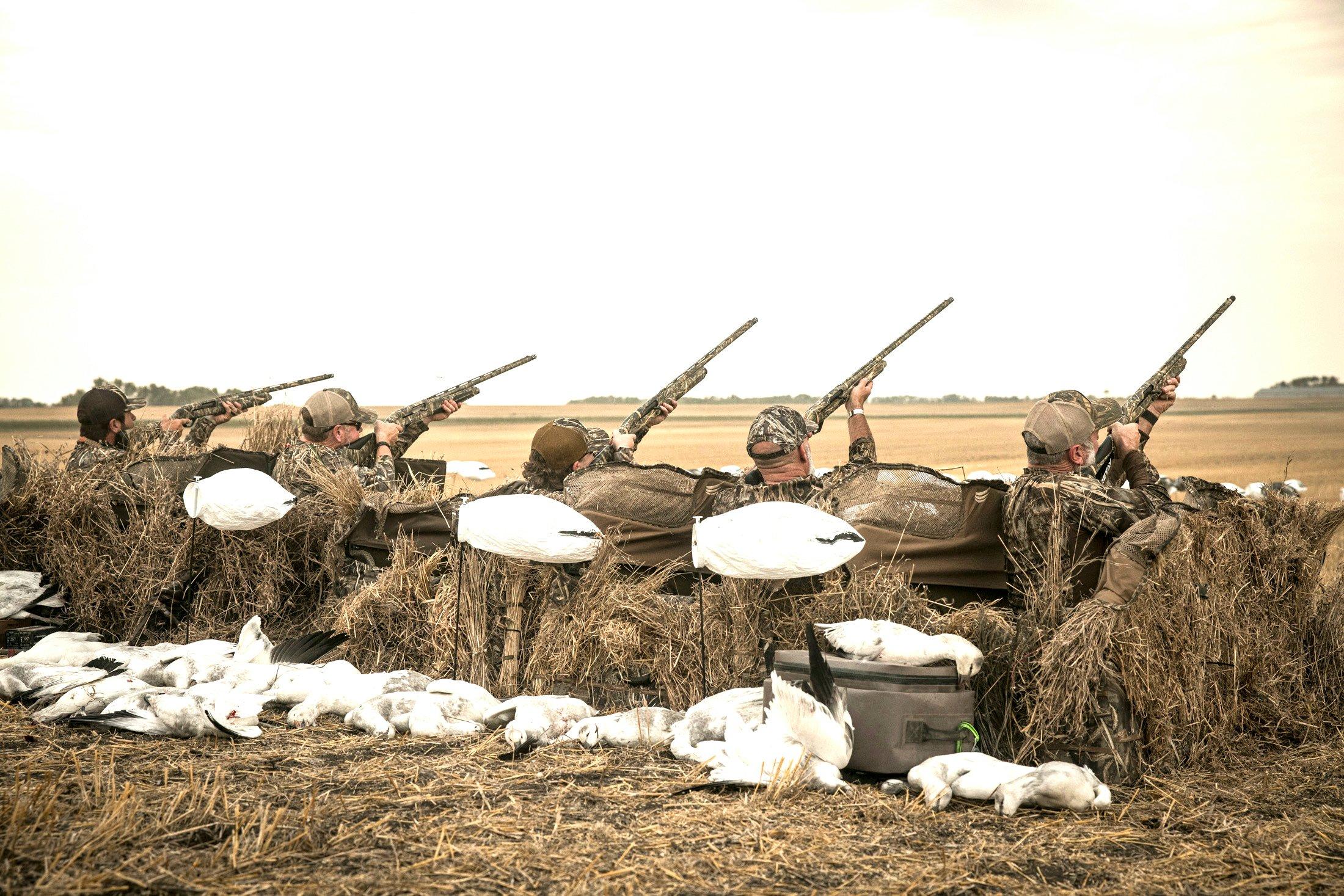
Guides try to center groups of birds over the decoys so everyone in the group can shoot. Photo by Realtree.
Calling the shot on a flock of ducks can be tricky, especially if birds are spooky and conditions are tough. If you yell “take ’em” too soon, you’re an impatient fool. But wait too long and that sure-thing flock disappears.
Those problems are compounded when you’re hunting with a large group. After all, everyone in the blind wants to get shooting, and you can’t just worry about yourself. Often, calling the shot correctly boils down to experience, observation, and intuition. And no one knows that better than waterfowl guides — guys who call the shots daily for expectant shooters. Here’s their advice for timing the shot just right.
Don’t Miss: No More Duck Bands? What That Might Mean for Hunters
BE PATIENT
Tony Vandemore, owner of Habitat Flats near Sumner, Missouri, said the biggest mistake hunters make when calling the shot is not giving ducks time to work.
“Once they are inside of 50 yards, some people start shooting,” he said. “You might scratch a couple, but if you wait until they are broken down at 15 yards, you will kill a lot more. You have to be willing to not get to shoot at some even though they came through kind of in range. Be patient, and let them get inside 20 yards.”
WATCH THE BIRDS
Veteran guide Cooper Olmstead, also of Habitat Flats, agreed that calling the shot might be the most difficult job of a guide. He assesses every opportunity individually and never hesitates to tweak his approach.
“Your hope is that the birds just do it perfect every time and make it easy on you,” he said. “However, we know that never happens. I just constantly watch the birds and am very patient, and sort of let them tell me what they are going to do. If they are not working well, I move decoys or motion decoys to get them to settle in how I want them to.”
Don’t Miss: Hot-Spotting and Duck Hunting Pressure
BUT DON’T HESITATE
Graham Greseth, owner of MaXXed Out Guides, said calling the shot for clients is different than if you were hunting with a few buddies. As part of that, a pit boss must be decisive.
“In a perfect world, every shot call would be as the birds are back-pedaling into the decoys, feet down,” he said. “While it’s different for every client, most are focused on the opportunity to squeeze the trigger. As guides, we want our clients to maximize every opportunity. Our guides are trained to take the shot when it’s there. Being greedy with the shot call can work at times, but more often than not, you’re stuck watching the birds fly away after you let them take one more pass. Shot calling is an art, and it takes an experienced guide that has a sense for how the birds are reacting each day.”
LISTEN TO THE BOSS
Rusty Creasey, manager of Beauchamp Duck Woods in Arkansas, said a large group of hunters must have a sole shot caller — a pit boss who maintains control over every opportunity.
“You’ve got to have someone in charge, right or wrong, calling the shot,” he said. “It can’t be a free-for-all where you have five or six guys stand up and shoot whenever they get a shot.”
Often, pit-boss responsibilities fall on the lead duck caller, as working birds and calling the shot go hand in hand.
“The timing of blowing your duck call and calling the shot are very similar,” he said. “Usually, the guide will have a better perspective and be able to see better. A lot of times, you might see a pair fluttering over the decoys and want to shoot. But if that guide hasn’t called the shot, he’s seeing something you don’t see, like maybe a group of 10 or 12 behind those two.”
Don’t Miss: How to Pull Off a Great Free-Lance Duck Hunt
Another big part of a pit boss’s job is making sure all hunters get in on the action, which can greatly affect the timing of calling the shot.
“As a guide, you really want to call the shot when the ducks or geese are centered up for everyone,” he said. “You might have birds come past one end of the blind, but you call the shot before they get to the other. And if you see in the morning that one spot is going to get a little more shooting, before you get too far into the hunt, you probably want to move some people around so everyone gets an opportunity at the hotspot.”