What Do Ducks See from the Air?
Posted 2026-01-08 by
Ever wonder why birds flare when they fly over? Observations from aerial waterfowl surveys reveals some fascinating insights
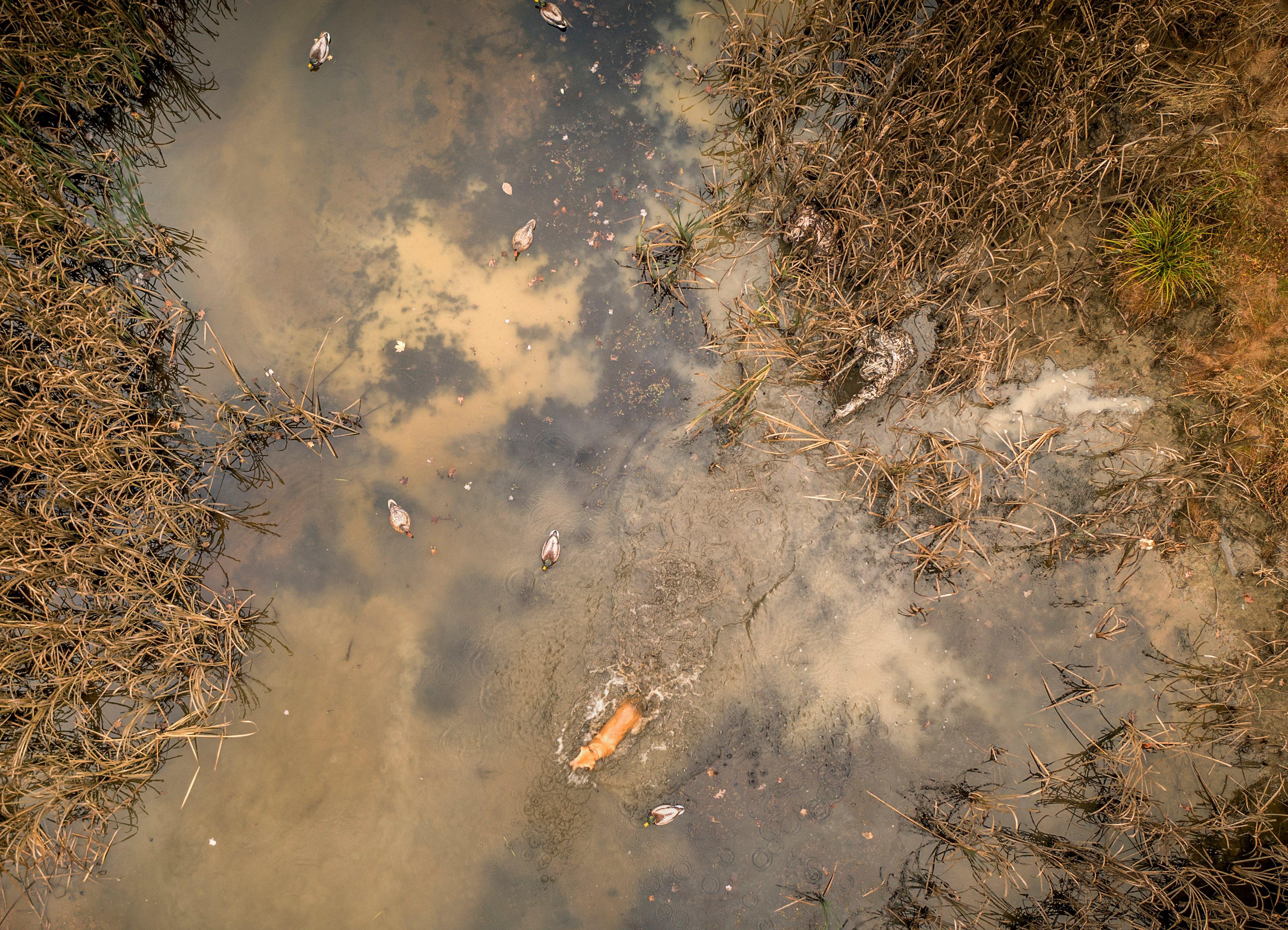
Many decoy spreads don’t look realistic when viewed from the air, according to a veteran waterfowl ecologist who conducts weekly aerial surveys. Photo by Bill Konway.
Waterfowlers and outdoor writers love to pontificate about what ducks see from the air and what puts them on alert. Such conversations are fun and constructive, but they’re also mostly conjecture, unless you get inside information straight from a duck — or maybe someone who regularly gets a duck’s-eye perspective.
Don’t Miss: 4 Ways to Bag More Flooded Timber Mallards
Enter Josh Osborn, a waterfowl ecologist at the Forbes Biological Station, a research station of the Illinois Natural History Survey that focuses on waterfowl and wetland ecology. As part of his work, Osborn conducts aerial surveys in spring and fall on the Illinois and central Mississippi River to monitor trends in waterfowl abundance and track the progress of the migration to aid in conservation planning. During peak migration, there might be 800,000 to more than 1 million ducks in the area. Much of Osborn’s aerial work focuses on refuges where hunting is not allowed, but he also flies over areas open to hunters and gets an eye-in-the-sky view of many blinds and decoy spreads, giving him a unique perspective about potential flaws in many setups.
“As a hunter, you can’t help but notice things,” said Osborn, who grew up in northern Mississippi and really got into waterfowling when he moved home in 2007 after serving in the Navy.
Many of Osborn’s observations during hunting season involve boat blinds, which can be difficult to hide, depending on the conditions.
“A favorite part of these early flights for [a colleague] and I is getting to see lots of different hunting setups,” he wrote Oct. 15, 2025, on the station’s Facebook page. “They’re as diverse as they are creative, and it’s always fun to see how folks adapt to their surroundings. Concealment is key, comfort is a luxury, and legality is, of course, important as well. Hunting in a big floating blind was a different beast for me when I moved here from the South. Most of my hunting had previously been standing next to a tree or grassed up in a small impoundment waiting for ducks to circle over. So even after 10 years, I’m still learning things about the big blinds. I often get asked what’s the thing that sticks out most when we see blinds from above. It’s always movement and faces. Always.”
Don’t Miss: How to Call the Shot Like a Duck Guide
Most duck hunters try to avoid such concealment mistakes, of course, but we don’t always succeed. And although it might be difficult to quantify how that affects success, the answer seems fairly straightforward.
“I don’t know how or if a bird does or does not respond, though I have my opinions,” Osborn said. “But if I can see it, I’m sure ducks can as well. In blinds, overhead cover isn’t as common as you would expect, and multiple black, dark holes stand out among the cover on the rest of the blind.”
Osborn and his pilot also see quite a few decoy spreads. Some appear realistic, but others fall a bit short.
“I believe different decoy spreads work in different conditions,” he said. “I will say that it’s uncommon that we get fooled by decoy spreads. My pilot and I call that ‘getting shot.’ Maybe once a year, we’ll be fooled by a decoy spread, usually in a place we aren’t expecting to see them. Usually those spreads mimic the distribution of birds on the water really well. Another common factor in those spreads is movement on the water, and I don’t mean spinners. We can pick out spinning-wing decoys really easily. Stale, stationary decoys with no movement stick out from very far away.”
Don’t Miss: How to Pull Off a Great Free-Lance Duck Hunt
Maybe Osborn’s observations confirm what most duck hunters have long suspected, but they also hold some insights that can help boost concealment and liven up your blocks. You can follow Forbes Biological Station on Facebook and Twitter.
?fmt=auto&qlt=default&fmt.webp.qlt=65&fmt.png.qlt=73&fmt.jp2.qlt=35&fmt.jpeg.qlt=60)