4 Ways to Bag More Flooded Timber Mallards
Posted 2026-01-06 by
There's nothing like decoying greenheads in green timber, but the classic hunting strategy involves several special considerations
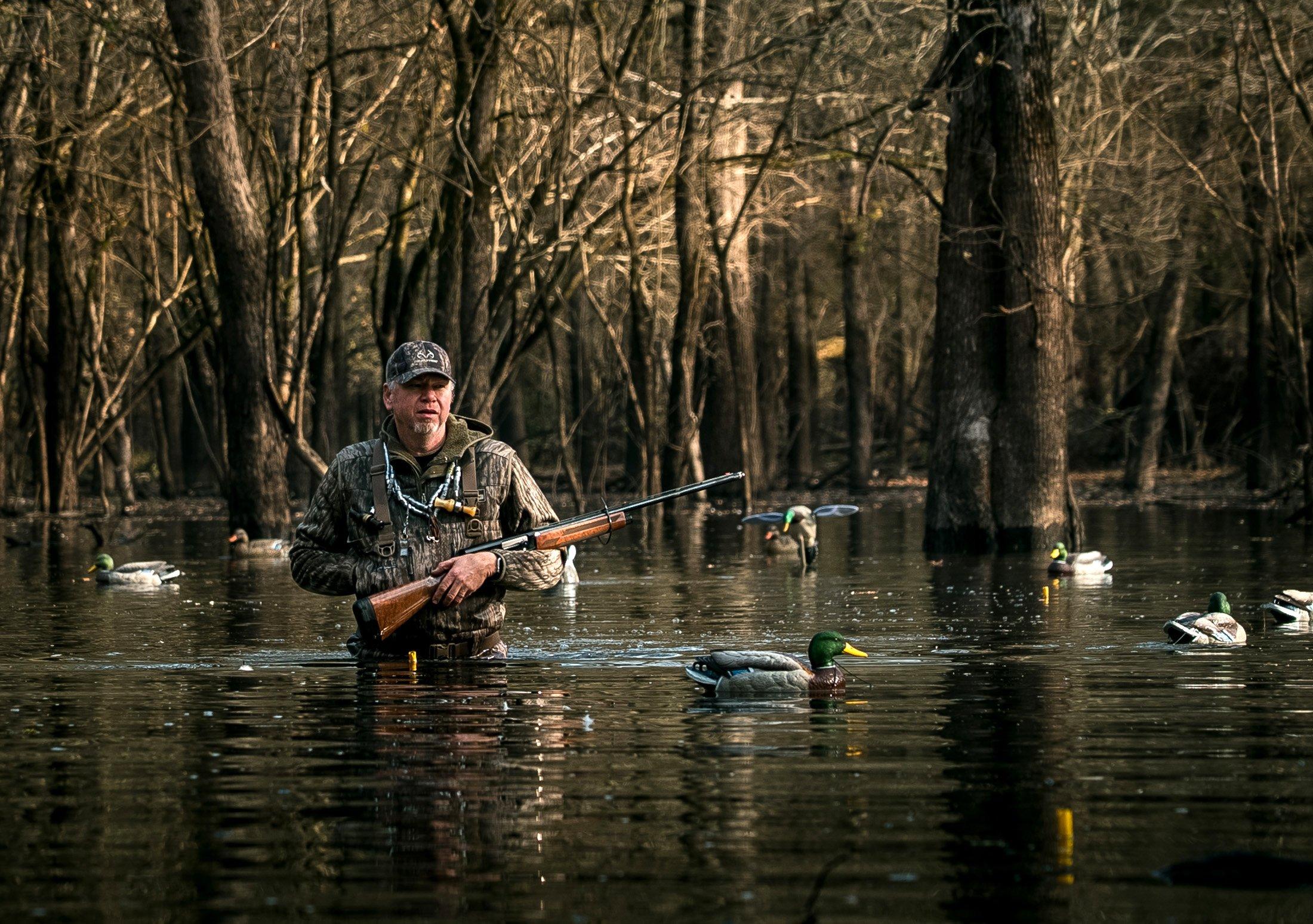
Timber hunters rely heavily on calling to attract ducks, but motion in your decoy spread is also critical. Photo by Realtree.
As January brings cold and snow up North, mallards are on the move, and hunters everywhere dream about greeting them in flooded green timber.
Whether on the Grand Prairie or the Mississippi Delta, classic timber hunting seems pretty straightforward: Snug up to a tree, bring your best calling chops, and see how you fare against the wariest ducks in the flyway. But experienced hunters know that green timber also has some nuances that can greatly affect success. And their tips might help this season, whether you’re a timber rookie or a seasoned veteran.
Don’t Miss: No More Duck Bands? What That Might Mean for Hunters
MAKE IT MOVE
Decoys often play second fiddle to calling in timber hunts, but they still serve an important role. And typically, realistic decoy movement is far more critical than spread size or shape.
“I think that motion is very important,” said veteran guide Cooper Olmstead, of Habitat Flats. “It’s a lot easier for flying ducks to see a disturbance in the water through trees as opposed to small plastic decoys sitting motionless on the water. I would err on the side of more motion than not, whether it’s spinners (if they are legal in your area), swimmers, splashers, jerk rigs, or even just kicking the water. Whatever you can do to maximize your motion and ripples on the water, I would do it.”
SCOUT WITH STEALTH
Scouting is important in any waterfowling scenario, but it can be tricky in timber. Hunters must observe ducks pitching into a timber hole or locate them on the water during daylight. And how you do that can be critical. Dennis “Dr. Duck” Loosier, co-host of Black Cloud on Realtree 365, prefers low-impact scouting.
“Boats create noise,” he said. “I like to walk ridgelines where the water meets the land and try to find ducks that way, and I try not to walk in water, as it makes noise. Try to mark locations as close as possible without disturbing ducks. I’ll mark it on onX or a GPS, but I also visually lock down on a bigger tree or an odd-shaped tree — anything that can help you identify the area without disturbing birds. You want them to feel as comfortable as they can the next day. Lots of young guys will boat in there, making all kinds of noise. But a duck will swim before it flies every time. They’ll swim 100 to 200 yards before they flush, and then those guys mark the wrong holes.”
Don’t Miss: Hot-Spotting and Duck Hunting Pressure
PICK THE PERFECT TIMBER HOLE
Ducks are where you find them, of course, but some types of timber holes seem to produce better than others. For example, oblong holes often seem to be better than perfectly round openings. And size can also make a difference.
“If it’s a little bit windier, you probably want to hunt a little bit more open hole,” said J.D. Driskill, owner of Dirty Rice Outfitters near Gobler, Missouri. “Most natural holes — probably 80% of them — are elongated north and south. Most aren’t perfectly round. So you want north or south winds. Preferably, we hunt on sunny days with south winds, but we really don’t get to choose that.”
Smaller timber holes seem to become more productive later in the season, but that’s not a hard-and-fast rule.
“I’ve shot them in small holes all season and big holes all season,” Driskill said. “It’s just kind of where they want to be. Toward the end of the season, they like to be in areas where there’s less pressure. Really, the size of the hole doesn't matter as much.”
BE READY FOR THE FINISHING TOUCH
Even shooting ducks in timber can be different than when hunting open water or dry fields. Birds that float down through the canopy and start to finish might seem like easy targets, but Realtree pro Chad Belding, host of The Fowl Life, said that can be deceiving.
Don’t Miss: How to Call the Shot Like a Duck Guide
“Once they get down into those woods and under those treetops, they’ll start to bounce,” he said. “Some will go to the left, some to the right, and some at your feet. When they’re below the trees, they lose the effect of the trees and just pick out where to land. Calling the shot is different in the flooded timber. It becomes a talent and an instinct you have to be able to master and not make any mistakes. You’re only going to be given a few opportunities on each timber hunt, so you want to make the most of them.”
?fmt=auto&qlt=default&fmt.webp.qlt=65&fmt.png.qlt=73&fmt.jp2.qlt=35&fmt.jpeg.qlt=60)
?fmt=auto&qlt=default&fmt.webp.qlt=65&fmt.png.qlt=73&fmt.jp2.qlt=35&fmt.jpeg.qlt=60)